Showing posts with label Mark_Morris. Show all posts

Monday, December 17, 2012

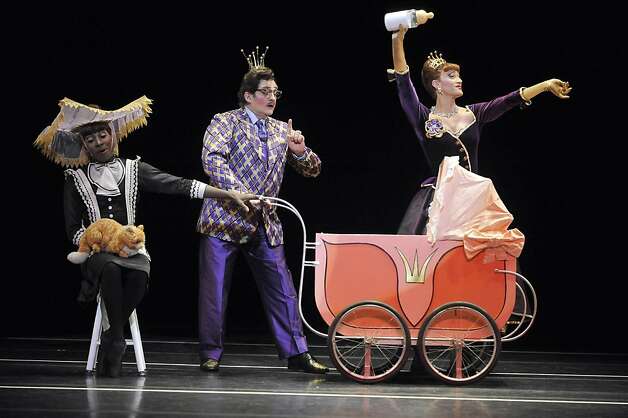
'Hard Nut,' Mark Morris, review: a crackup

There are days when you just need something to cheer you up, especially during a holiday season darkened by ineffable tragedy. If the drollery of Mark Morris' "The Hard Nut" - which returned to Cal Performances this weekend with shows that run through Dec. 23 - is insouciant entertainment that surely doesn't profess to change the world, it's also a gleeful romp with the power to make you laugh in moments when laughter is hard to come by.

In an essay titled "Why Comedy is Truer to Life Than Tragedy" this year, Wall Street Journal critic Terry Teachout observed, "In most human lives, absurdity and sorrow are woven together too tightly to be teased apart." I couldn't help but think of those words and consider the vital necessity for the sort of tension-relieving exhale that "The Hard Nut" provides as the lights went down at Berkeley's Zellerbach Hall on Friday night. We need comedy, if only to help us cope with the cosmic absurdity that is human frailty.

Read more: 'Hard Nut,' Mark Morris, review: a crackup

Thursday, February 16, 2012

Ballet's candy-colored 'Beaux' plays with imagery

One might think that "Beaux" is the kind of piece that should not be taken too seriously. And yet, underlying the frolicsome cascades of sideways split jumps, and lofty sautes that bound across the space with the head thrown back, Mark Morris' eighth creation for San Francisco Ballet, which premiered Tuesday at the War Memorial Opera House, asks for a deeper examination of personal premises.

Set to neoclassical works for harpsichord by 20th century Czech composer Bohuslav Martinu- conducted on opening night by Martin West - the candy-colored camouflaged piece feels larky, even goofy. Yet, the air between the guys dancing - an egalitarian mix of principals, soloists, corps members and one apprentice working together mainly in triads - is one of gentility and collegiality.

Dappled with Isaac Mizrahi's neon piebald patterns, against a similar large-scale backdrop devised also by Mizrahi, the nine men - Sean Bennett, Jaime Garcia Castilla, Diego Cruz, Ruben Martin Cintas, Vito Mazzeo, Pascal Molat, Gennadi Nedvigin, Jeremy Rucker and Benjamin Stewart - cavort companionably, occasionally evoking thoughts of a band of colorful fauns gamboling in a cartoonish forest. The men of "Beaux" are playful, curious, innocent. So why does it seem, at first glance, so unmanly?

Ballet's candy-colored 'Beaux' plays with imagery

Sunday, January 15, 2012

S.F. Ballet plays to its strengths in 2012 season

If San Francisco Ballet's exhausting, whirlwind schedule takes a toll, director Helgi Tomasson isn't showing it as he sinks comfortably into the couch in his office in between fittings for the costumes for San Francisco Ballet's new production of Don Quixote and rehearsals for the company's upcoming production of "Onegin."

But then perhaps everyone is simply used to this level of activity, as the company prepares simultaneously for the launch of "Onegin," the opening gala and well, pretty much the entire run of the 79th season's 18 ballets.

San Francisco Ballet 2012 season at a glance

"Chroma," "Beaux," "Number Nine" Rich textures interplay with dramatic color on a mixed program of works that push the boundaries of ballet. Wayne McGregor's riveting "Chroma" stretches the classical lexicon to eye-catching extremes to create a kind of hybrid vernacular to match the pulse of modern life. With "Beaux," Mark Morris creates his seventh commission for the Ballet, using the jaunty music of Bohuslav Martinu as a springboard for nine men to show off a different side of male virtuosity. The evening concludes with the return of Christopher Wheeldon's commission from last season, the high-velocity, kaleidoscopic "Number Nine."

Friday, September 18, 2009

Mark Morris Dance Group's ethereal 'Visitation'

In a world of dizzying and doubt-inducing complexity, there's something refreshing about the kind of direct and lovely simplicity that marks "Visitation," which the Mark Morris Dance Group performed to open the Cal Performances season at Zellerbach Hall on Thursday night.

Seemingly suspended in a state of expectancy, "Visitation" (set to Beethoven's sonata No. 4 for cello (Wolfram Koessel) and piano (Colin Fowler) is suffused with a kind of intimate anticipation. Groups break into pairs, dancers shift partners, intermingling duets for Joe Bowie, Noah Vinson, Michelle Yard and Rita Donahue pulse between sharp and soft, but throughout there's an ecstatic impulse in repeated arched backs and faces upturned toward the heavens as if hunting for salvation. And at the heart of the piece is a pensive Maile Okamura - a kind of outlier, though not an outsider to the group of nine dancers. Okamura invests the Beethoven score with a delicate yet passionate touch and it's infectiously delightful to watch her take to the air, hair flying across her face.

Read more at the SF Chronicle site.

Wednesday, September 26, 2007

Mark Morris' "Mozart Dances" at Cal Performances

Sept 21, 2007
Zellerbach Hall, UC Berkeley

I worry when a choreographer makes a full-evening length dance that works--one that's not a story-ballet or a polemic, that can keep an audience focussed and not fidgeting in their seats as you begin section 11 of a 12-part work.

Aw, hell, I think to myself, now every yahoo is going to think that they're as skilled as Mark Morris -- that they can pull off a whole night's worth of abstract modern dance just like "Mozart Dances," which had its West Coast premiere at Zellerbach Hall at UC Berkeley recently. He makes little things like organic form and reformed structure look too easy.

Facetiousness aside, however, Morris impressively leads the audience on an engaging excursion through a beautiful three-act work set to Mozart's Piano Concerto No. 11 in F Major, his Sonata in D major for Two Pianos, and his Piano Concerto No 27 in B-flat Major.

To call it ambitious would be patronizing. Morris is too canny a dancemaker to attempt a large scale work without thinking through the nuts and bolts and "ambitious" implies a certain amount of failure in the very word. "Mozart Dances" is not my favorite of his works-- I reserve that title for his exhilarating "L'Allegro"-- but it is both satisfying and successful on a grand scale.

The tone here is simple rituals, with shades of 18th century airs and graces, reflected in Martin Pakledinaz's black and blue-gray knee breeches for the men and diaphanous dresses for the women. Broken into a section mainly for women ("Eleven"), one mainly for men ("Double") and one for a happy intermingling of both genders ("Twenty-seven"), Mozart Dances seems to allude to everything and nothing. A wry comedy of manners? Sistahs doing it for themselves? Menacing, dangerous liaisons?

Morris famously admires the work of George Balanchine, and there's several "Serenade"-like moments of scattered throughout the evening -- the dramatic, plunging swoon to the floor, the gauzy moonlight skirts of the women during their brief interlude in "Double," the second act of the evening.

And yet it wasn't Balanchine that "Mozart Dances" evoked for me, but rather the earlier grittier "Les Noces," by Bronislava Nijinska, circa 1923. It wasn't the score -- Mozart is rather different from the pounding, earthiness of Stravinsky's peasant wedding -- but rather the look of things.

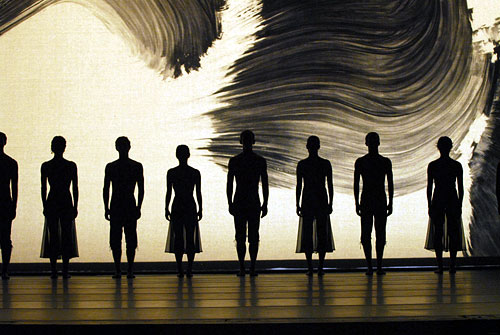
The stark force of Howard Hodgkin's curtailed, painterly brush-strokes-- writ-gargantuan on the cyc in the back-- the architectural groupings and waving of the women in "Eleven" recalled the severe austerity of Nijinska to my eye. Almost certainly, Morris had no intention of evoking a Nijinska's broadly-drawn modernist ballet, but all the same, my mind, grasping for narrative threads, settled on this one.

That there is a ritual feeling throughout "Mozart Dances" is no surprise, given Morris' mastery of the folk dance forms. The weaving patterns of the women as they wound in and out of Lauren Grant's dance in "Eleven" called up the braiding of the bride's hair in "Les Noces'" first tableau. Two poignant solos for other women brought to mind the lamenting mothers of the third tableau. And then the mixture of dreamy sentiment and manly urgency in "Double" made me think of the Consecration of the Groom scene. By the time the curtain rose on Hodgkin's final image -- this time featuring an angry red swath across the space, like virginal blood displayed on the wedding sheets -- I was sure I had the story nailed.

Am I way off-base with my Russian Peasant Wedding theory? Almost assuredly. Reviewing the "Mozart Dances" in the New Yorker, Joan Acocella reports that Morris himself cites the madcap ending of Mozart's opera buffa "Cosi fan tutte." Fair enough. Mozart's pretty far from Russia.

It doesn't stop me from secretly clinging to my theory. After all, that's the flexible pleasure of abstraction. Choose your story and run with it.

For more information, check out cal Performances'
extensive webpage on the event with links to video clips and program notes.