
 Choreographer Trey McIntyre is what you might call an American original. His mix of balletic structures with contemporary flair has a refreshing directness and has made him one of the most in-demand dance-makers of his generation. A Kansas native, McIntyre now makes his home in Boise, Idaho, where his eponymous company, the Trey McIntyre Project, is based.
Though he’s made scores of works for companies from Stuttgart Ballet to Houston Ballet to American Ballet Theatre, McIntyre has recently concentrated on creating pieces for his own company. This season however, he’s been coaxed to create a new work, Oh, Inverted World, for Smuin Ballet, and we sat down to talk about his process and his work.
Tell me about the piece that you're working on for Smuin Ballet.
It started off with the music, which is the first album that the Shins produced. I had met James Mercer--who was the singer and principal songwriter for the band--met them back in the day. He and I had talked about maybe working together on a commissioned work, creating music specifically as a dance score. But then things got busy, they got famous, and there was no even getting to them. But it's music I've always responded to. I think it's just brilliant.
What is it about the music that really captures you?
A couple of things. As pop music, structurally and tonally, I think it's very creative and interesting way that he comes at it. The other thing is that with pop music I really tend to ignore words, ignore lyrics, because they're usually silly. But in this case the poetry is gorgeous. I’ll chew on it all day, I’ll think about a line from the piece and really try to get behind it. It’s just so evocative. So in this case, the words matter—not narratively, there’s not a narrative to the piece at all—but there is always definitely a relationship, and it may just be the sounds of the words, the rhythm, the way it rolls off your tongue.
I guess I tend to work with pop music a lot because with certain artists, I take them seriously. I think there’s incredible artists working in that genre. But also, you know, pop music as an American is the soundtrack of one’s life. And it’s not necessarily the storytelling of the music, but – at least I have experienced this—it’s that I associate certain events in my life, there might have been a radio playing in the background or a song that I went to after something happened and there’s a relationship and an emotional content in the presence of the music. So I think that’s why I keep going back in that direction.
Your style is often described as fresh and very American—although I often struggle with that definition of what makes a dance piece “American.” Do you see yourself as a distinctively American choreographer?
I do, for sure.
 What do you think that is?
I know what it is for myself--as a “movement” I don’t know that that exists right now. Part of it I think has to do with coming from Kansas, because there’s a geographic way of being in space. There’s something about living in the Great Plains where you have a sense of expanse, a sense of groundedness, earnestness. I just remember growing up, relating to people in a way that was so straightforward—you get what you get. And good, there's an essential desire to move toward good, to do the right thing and live with an ethic.
So I feel like, movement-wise I create work that is grounded, of the earth, straightforward. I’m constantly coaching dancers away from acting. Ballet has so much built in that, to me, veers toward sentimental at its core. The incline of the head, certain postures--suddenly it goes to a place that I know is inauthentic when I see a dancer do it.
Like a certain formality to it?
Sure, yes, formality is one part. And also stylization—it’s an affect. I really feel like dance, if it gets right to that seed inside of you, if you can get to that place, it’s true, it comes from an authentic place.
There’s a great Stanislavsky quote from acting training—a concept of teaching really, that basically says “real experiences in imaginary circumstances,” which I think is absolutely what I’m trying to get to with dancers. Because I think as an audience member, in any performing art, I respond to the person on stage– they’re showing me, me. So if it’s an approximation of that, I’m only seeing my worst parts. I’m seeing my false self, my ego-filled self, trying to pretend or be something. As an artist I really want to expose and lay bare. Then I think the product ends up being original because it’s true to who you are—it speaks to some bigger truth.
And so, somehow to me that’s an American quality. I don’t know if everybody sees it that way, but I think that’s just how my upbringing is.
I think that’s why ultimately I’ve gravitated toward a smaller town and Boise, Idaho really supports that. It’s a slower pace of life and it’s very community-minded, you know? We all do this together. If there’s a lot of noise in my life I get distracted very easily.
Now does that balance out, do you ever feel that you’re too far removed from the dance community and what’s going on?
No, (laughs) I feel that I’m just right removed from the dance community. I tend to really avoid the dance community altogether, and at least for me as a choreographer, I think that’s important. I would say this to any young choreographer: see everything, learn from what you love, learn from what you hate. But then, I think you reach a certain point where there’s not anything to be gained by seeing other dance. And I think that with dance, maybe more specifically than anything else, there’s something about watching it—your own muscles fire on some level seeing someone moving, even if it’s tapping your toe--there is a physical reaction to it. So I think you digest what you see in a way that it becomes yours, and then it’s very easy for it to become part of your choreography.
I make a conscious effort to really not see a lot of other work. Just for the very reason that I think there isn’t a true force of American dance right now, at least I don’t think so. I want to go somewhere totally different, I want to go get lost on this path and maybe it’s the right path and maybe it’s not, but at least I want to move towards something new and forward, as opposed to being part of a bigger picture where everyone is moving in the same direction.
Coming back to the piece you’re creating for Smuin Ballet, do you have a title? And how did you come to make this piece now?
Yes, it’s the same as the album, it’s called Oh, Inverted World. I can’t tell you why this album was lodged in the forefront of my mind, but every piece happens like that. I’ll sit on music for a decade, and then all of a sudden, “Today’s the day for this piece,” and that was the case here.
Can you tell me a little bit about it?
I first heard the music when I was in my early thirties, and as somebody who was just entering into a relationship, I was really seduced by this music—I was courted with this music. And I look back at that time, at how I was searching for identity at that period of my life and how powerful music can be in that way and how it can awaken certain things in you. When I first heard this music in my mind this whole world opened up --overnight this possibility of who I wanted to be and what was possible. And not all of it positive—at the time I was abandoning certain parts of myself just because I was so tantalized by this world I had invented.
It makes me think a lot about how we tend to do that as people—we want to be passionate about something without thinking it through. A whole society can move in a direction that way. So I guess, I’m really in the piece exploring those ideas in myself, in some ways creating that fantasy world and also exploring some of the sadness that came along with that at the time, the heartbreak as well.
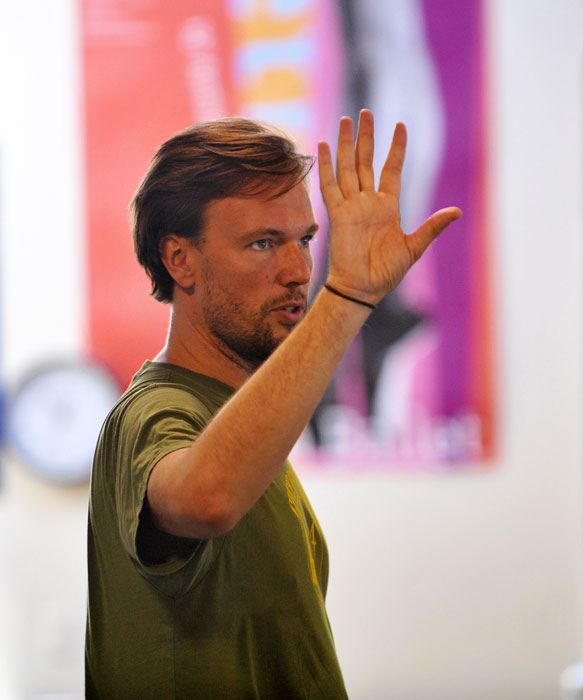 So is it that you felt that you were choosing a particular identity to become, or choosing something to pin yourself to, or was it more that something presented itself and you just decide that was the track you could take?
It was more that latter. And I don’t even know how conscious it was. Part of it was the idea of really being courted so aggressively by somebody in that way was just so tantalizing. Everything about it seemed incredible, but it’s not until that relationship ended that the curtain gets pulled back and all of a sudden you realize, “Oh I really just abandoned myself.”
But I have to say, I don’t know to what extent that’s then what the piece becomes about. Not until the curtain goes up that I say, okay, I see how all those pieces fit together. But those are the things I’m thinking about right now in making the work. You know, I never really understand the work until it’s done. I try to go directly from my own subconscious—I guess getting back to that idea of really getting to what’s most honest. Making choreography to me always feels like the piece is over here already…and if I turn around it’s going to stay behind me, so I’m just trying to get out of the way of it--get my own ego out of the way, my own need to say “I want to make a great piece, I want to impress somebody.”
To what extent does it matter what dancers you’re working with?
Oh, it’s everything. Really. This is the first piece that I’ve made on a company that isn’t Trey McIntyre Project since launching the company full time (in 2008), so it was a big deal. With your own dancers, working with them every single day, the personal advancement has been incredible, I can just keep building and building and building. And that was one of the reasons why I didn’t want to freelance anymore—because I was just so tired of starting over again with new dancers.
And speaking of distraction, I have a very specific way of working--it has to be a very quiet, very focused studio. “Zen” might be even a good word to use. That level of focus is so important to me. I take every nuance seriously in the creation—there’s not a wasted gesture, and so the dancers need to approach it the same way, with great care about what all those details mean. So if there are people that can’t work in that way, I just shut off—switch just shuts off. So I am, and will continue to be very selective about what other companies I’ll work with. It’s very rare that dancers as a group can have that level of sensitivity and focus, and that’s definitely been the case here. It’s been a real joy to work with these dancers.
Choreographing is incredibly vulnerable. I think that personality-wise, I really fell into the wrong profession. I think I’d be a much better painter—you know, just locked away in a room somewhere. I’ve had to acquire the skill of being able to create with people staring at me. It’s not natural to me—I don’t crave being in charge of a room full of people that way. I love the relationship and like finding things within people and helping bring that out. But the level of focus on me is uncomfortable.
So you’re not one of those choreographers who comes in with steps already set and ready to go?
Oh no, no way, not one step. For me it’s been better, the less I can prepare, the better the work is, the more that it’s just absolutely of that moment. Sometimes I’ll even try it--I’ll come up with one phrase the night before and inevitably I will always throw it out. I guess I just really need it to be of that moment—who we are as people reacting to each other. I’ll make a phrase of eight counts and then watch them and see where they go with it, then start to shape it. And then maybe wow, the way she moved her shoulder, I really like that approach, and let’s follow that line. Then it becomes like a tree, branches start to grow off and that’s how the piece comes about. So I’m not looking to them for steps, but it’s collaborative in that I’m finding opportunities in them.
====================
Smuin Ballet performs Oh, Inverted World along with Bluegrass/Slyde and Brahms/Haydn Variations from October 1-9 at the Palace of Fine Arts Theater in SF. The program repeats Feb 4-5, 2011 at the Lesher Center in Walnut Creek and Feb 23-27 at the Mountain View Center for the Performing Arts on the Peninsula. For more information, visit www.smuinballet.org
Photos by David Allen, courtesy of Smuin Ballet.

