Showing posts with label dance_festival. Show all posts

Saturday, August 17, 2013

Strength and silliness in summer dance show

Photo: Matt Haber
Strength and silliness in summer dance show:

In dance, summer has traditionally been a time for choreographic experimentation. As with any experiment, there can be hits and misses - sometimes both in a single night, as was the case at Safehouse's sixth annual Summer Performance Festival, which started Wednesday night at the ODC Theater with Jenni Bregman & Dancers and BodiGram.

Of the three recent works that Bregman showed Wednesday, "Context," a meditation in four sections for nine dancers, made the strongest statement. The 2012 work found Bregman and her eight dancers, clad mostly in shorts with loose-fitting tops, with a chic Gina Levesque in a red suit engineering mysterious yet satisfying encounters in duets and groups to a throbbing original score created by Sunshine Jones.

For the most part, Bregman's choreography bends earthward in some arresting moments. Dancers whisked ramrod arms through the air with eyes cast pensively downward, and Marco Chavez Jr. hurtled compactly yet silkily across the floor. The lighting design went uncredited in the program, so it's hard to know whether the rather intriguing moire effect on a scrim behind Bregman's solo was intentional, but nonetheless, it lent a dizzying constant shift to her restive solo.

Following on the program was "Force," an earnest, yet not terribly revealing solo for Bregman, and "Home," a childlike adventure for six dancers, whose ideas were sketched out more succinctly in the drawings created on sheets of butcher paper than in the actual choreography or execution.

The Summer Performance Festival is curated by Joe Landini, director of the performance space the Garage, where many of the works on the festival's five-day program were forged. The SPF6 is the opportunity for these artists to transfer their efforts to a larger venue. Bregman's troupe is one of eight that perform through Sunday, including Aura Fischbeck Dance, Gretchen Garnett & Dancers, Angela Mazziotta, the Milissa Payne Project, Nine Shards, Vinnicombe/Winkler and BodiGram, who performed in the second slot of the doubleheader on Wednesday.

On re-entering the theater Wednesday night to be confronted with a simulacrum of a speakeasy-cum-dance hall scenario in which we were exhorted to have a drink and dance, I realized at once that we were meant to have "fun." The heart sank. To say that BodiGram's ill-conceived "D.R.U.N.K.S," choreographed by Blair Bodie and Julia Graham, was a frivolous miss would be a kindness.

What followed after 15 minutes of standing around was a performance that was as frustrating as it was sloppy - a juvenile, unfunny parade of lampoons depicting drunken debauchery. To say it devolved would be inaccurate, as this would imply there was some kind of high point involved.

Bodie, Graham, Tara Fagan and Korie Franciscus roll about onstage, do a bit of line dancing and pose fitfully while Shannon Preto dispenses drinks (yes, actual Tequila shots and Tecates) to the audience members, in what must have been a misguided impression that a shot of Tequila would help the silliness go down.

Landini reportedly considered some 120 entrants for the residencies at the Garage that led to slots in the festival. It's hard to believe that he couldn't find a work that would have been more deserving than "D.R.U.N.K.S" of the wider exposure that the Summer Performance Festival affords.

Thursday, June 27, 2013

El Wah Movement performs at Ethnic Dance Festival

Photo: RJ Muna
El Wah Movement performs at Ethnic Dance Festival:

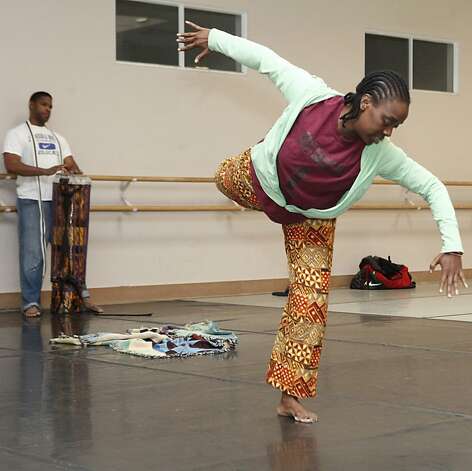
In Haiti, the mystical Rada spirits protect and provoke justice, counter dishonesty and inspire vitality and energy. It is these lwas, or spirits, that El Wah Movement Dance Theatre invokes in its dance, "Rele Tout Bon Moun Yo (Call All the Good People)," performed this weekend by the troupe - one of 10 dance groups that take the stage during the final week of the Ethnic Dance Festival at the Lam Research Theater at Yerba Buena Center for the Arts.

The news from Haiti is so frequently grim - earthquakes, political unrest, epidemics - that oftentimes the beauty of the island is forgotten. A score of dancers and musicians, including Haitian dance icon Blanche Brown, bring to life the color, ritual and pulse-pounding drumming in an adapted version of a traditional Haitian prayer.

Colette Eloi, a Haitian native who directs the 8-year-old company, choreographed "Rele Tout Bon Moun Yo," and also sings during the performance, dedicated the piece to the people of the world who came to Haiti's aid after the earthquake of 2010, which devastated the island nation, and from which the country is still recovering.

On Saturday night before the performance, Eloi and Brown will be joined by Deborah Vaughan and Latanya D. Tigner of Dimensions Dance Theater, who also perform at the festival this weekend, on a special panel moderated by Ethnic Dance Festival co-director CK Ladzekpo that will discuss the history and future of dance from the African diaspora.

Thursday, April 11, 2013

CubaCaribe Festival of Dance and Music

Teatro de la Danza del Caribe, Photo: Jamaica Itule Simmons
CubaCaribe Festival of Dance and Music:

The inspiration of teachers is very much on Ramón Ramos Alayo's mind as he and his eponymous company get ready to host the ninth annual CubaCaribe Festival of Dance and Music, which kicks off this weekend at Dance Mission.

The three-week festival, he says, was designed as a celebration of Caribbean dance, music and culture with the first weekend highlighting local dance groups including the Afro-Cuban Arenas Dance Company, the all-female Las Que Son Son and the Brazilian-inspired Sambaxe.

Then on April 19, one of Cuba's most highly regarded modern dance companies, Teatro de la Danza del Caribe, will make its U.S. debut at the Forum at the Yerba Buena Center for the Arts. The festival culminates in a third weekend of joint performances at Laney College in Oakland featuring the Cuban company and Alayo's own Alayo Dance Company in works that he choreographed for both troupes.

There are two big modern dance troupes in Cuba, Alayo says, observing that the national modern dance company in Havana shows more international influences, while the 25-year-old Danza del Caribe, based in Santiago, retains more of a distinctive blend of native Cuban folkloric culture.

"Cuban modern technique is based in (Martha) Graham, (Jose) Limón and (Merce) Cunningham mixed with Afro-Cuban," he says. "With the Santiago company, you really see the undulating movement and the folklore mixed into it."

Among the works on the second week's one-night-only program are Danza del Caribe signature pieces like "Sulkari" by Eduardo Rivero-Walker, who Alayo regards as one of the most renowned choreographers in Cuba, as well as his mentor and teacher.

It's a bittersweet moment for the Cuban-born Alayo, who was a principal dancer with Danza del Caribe in the 1990s and who wanted to bring Rivero to American audiences for years, he says, but Rivero died from lung cancer in November.

"He was one of the smartest persons I know," Alayo says. "Tough as a teacher, but good. If you didn't know how to dance, and you danced with him, after you finish you could do whatever you wanted because he could take you where you want to go. He had the vision to see what you could do.

"The way I move is because of him. How I use my arms? Because of him. The way I teach and choreograph is the way I saw him do it. For me he was a model."

Thursday, February 7, 2013

Black Choreographers Festival: Tigner

It wasn't a dream - the drums playing a mysterious rhythm that Latanya d. Tigner heard every night in Congo. Still, no one else could hear them it seemed, and so she concluded they must be talking directly to her for a reason.

Those drums and the many experiences Tigner brought back with her from a 2010 visit to the Republic of the Congo inspired her latest choreographic venture, "Ndozi/BaNkaka: Those Who Sit With Us," a collaboration with drummer Kiazi Malonga that features on the second of three weekends of the ninth annual Black Choreographers Festival, which begins on Saturday.

It was on her first night in Brazzaville, Tigner recalls, as she turned into bed, that she heard the drumming.

Read More: Black Choreographers Festival: Tigner 

Thursday, January 17, 2013

Ethnic Dance Festival's public auditions

This weekend, a world of dance comes to the Yerba Buena Center for the Arts, as hopefuls from ethnic dance troupes across Northern California will audition for the 35th annual San Francisco Ethnic Dance Festival.

"It's a great way to see the wonderful variety of cultures we have in this area," says Carlos Carvajal, co-artistic director of the festival. "Nowhere else can you do an international festival of this range in which all the participants live locally. Usually festivals as diverse as this have to bring people from other countries, but we have Mexico folklorico dancers, Indian dance, Spanish, Middle Eastern, Tibetan - and they're all local artists."

Read more: Ethnic Dance Festival's public auditions

Thursday, August 23, 2012

Last call for WestWave Dance Festival

"Sometimes you do yourself in," says Joan Lazarus, director of the 21-year-old WestWave Dance Festival, which presents Maurya Kerr's Tinypistol on Monday at Z Space.


It's a single performance that closes the door on the history of this summer tradition, headed for 17 years by Lazarus, who says she leaves WestWave with few regrets after a rewarding and difficult year. 

In the 31 years since Lazarus arrived in the Bay Area, she has been a maven in the unsung arena of arts administration - an unabashed cheerleader for the dance scene, who served as executive director of Oakland Ballet, managed the Cowell Theater, guided the capital campaign for ODC's new facility and helped steer the annual Bay Area Celebrates National Dance Week, in addition to running her own nonprofit DanceArt, which sponsored the WestWave Dance festival every summer. And yet Lazarus is philosophical about her departure and the confluence of events that have led to it.

Highs and lows 
Speaking by phone from her offices in Steamboat Springs, Colo., where she is now executive director of the Perry-Mansfield Performing Arts School, Lazarus spoke frankly about a whirlwind year that went from the high of WestWave's 20th anniversary season to a funding desert that left the festival with only one performance and serious questions about its viability.

Under the aegis of DanceArt since 1998, WestWave boasted more than 2,000 performances, featuring hundreds of choreographers from the Bay Area and beyond. Lazarus often worked on it without a salary to keep the budget for the festival, which ran around $75,000, as small as possible.

"WestWave was a bargain, and that's one of the reasons I would get so frustrated," Lazarus says. "Because what we could manage to do for that small amount of money was tremendous - it was very lean and mean, but we needed at least that much to do it, and it's just gotten harder and harder to raise."

Lazarus describes the funding challenges of the past year as "the perfect storm," in which the festival strangely became a victim of its own success.

After a banner 20th anniversary season that featured nine programs and stretched from July through October, Lazarus hoped the momentum would continue. She sought grants from a dozen agencies, but was disappointed to find that only a handful of funders were prepared to support the festival. "They said, 'You had such a great year last year that we're sure you'll be able to garner new support, so we decided to give to someone else,' " she says.

Without enough money to secure a theater, much less move forward with planned programming, Lazarus e-mailed the hundreds of friends, artists and administrators with whom she had worked over the years, but was again disappointed to receive only 30 responses.

"And it wasn't the artists who donated - only about three or four choreographers pitched in, and that was a very clear indicator to me," she says pragmatically. "Organizations and projects have life cycles like anything else. So when I had the offer in April to come to Perry-Mansfield, it made my decision really easy. It wasn't, 'Oh, you can't leave because WestWave needs you to keep going.' It felt like my time here was done."

The forthright Lazarus is quick to note that WestWave stalwarts like Janice Garrett, Amy Seiwert and Benjamin Levy were able to use the festival's open-ended, "try anything" approach to their advantage, testing ideas for new premieres without having to produce themselves. And Lazarus has often seen WestWave as an opportunity to give a boost to promising talents.

Three works 
One such artist is Maurya Kerr, whose Tinypistol company will present three works at WestWave's only performance this year. Kerr first came to Lazarus' attention during last year's gala, when she was looking for a ballet choreographer for the program.

"Someone recommended Maurya, so I called and said, 'You know, I haven't seen any of your work, but I'm just going to ask you, is it good?' " Lazarus recounts, chuckling at the memory. "And she said, 'Yeah, I think you'd be happy.' Working with her was so easy - when I needed information she sent it, her company showed up on time, they didn't whine, they didn't ask for things we couldn't provide. She just did it, and it was fantastic."

Lazarus held on to that memory while planning this year's offerings. Then, with only $7,000 in the bank from a few long-standing supporters, she made a decision based on gut instinct. "After the 20th anniversary gala last year, I had asked Maurya if she'd ever shown a full evening of work, and she said no. So I offered her a full evening. Even as things began to dwindle this year, I was unwilling to take back this offer," she says simply.

"And if little WestWave can offer an opportunity to someone who doesn't have an organization yet, who doesn't write grants, who just has a strong body of work - well, it's a real privilege to be the person who can make that happen for them. As everything else slipped away, I had to make the choice. We could only do one concert - I could either present five artists who've done this before, or I can still do this for her, and to do that felt really nice."

WestWave Dance: Maurya Kerr's Tinypistol. 8 p.m. Monday. Z Space, 450 Florida St., S.F. $18-$23. www.westwavedance.org, www.brownpapertickets.com. 

Read more:Last call for WestWave Dance Festival

Wednesday, March 28, 2012

Dance: 26th Annual Izzie Awards presented

An atmosphere of casual collegiality pervaded the crowded ODC Theater on Monday night as the Bay Area dance world gathered for the 26th Annual Isadora Duncan Awards, affectionately known as the Izzies, hosted by choreographer Val Caniparoli and Oakland cultural maven Denise Pate-Pearson.

In the production categories, Lines Ballet's production of Alonzo King's "Scheherazade" was a big winner, taking home awards for music and visual design.

Miami City Ballet director Edward Villella was on hand to present a Sustained Achievement Award to Deborah DuBowy for her ongoing lecture series "Words on Dance."

Still, there was a sad irony in that Cathleen McCarthy and Joan Lazarus received kudos for their work with the WestWave Dance Festival in a year when harsh economic realities have forced a scaling back of much of the summer festival's performances. Among the literally thousands of artists whom WestWave has brought to the stage were Alex Ketley, Kara Davis, Katie Faulkner and Manuelito Biag, whose collaborative effort "Terra Incognita, Revisited," which debuted last year on a WestWave program, took home top choreographic and company performance honors.

For a complete list of nominees and winners, visit www.izzies.org.

Dance: 26th Annual Izzie Awards presented

Saturday, December 3, 2011

Left Coast Leaning Festival review: hit and miss

"What are you trying to say?"

It's a question that could be sardonic, frustrated or genuinely curious, and the latest edition of the Left Coast Leaning Festival, which opened at the Forum at the Yerba Buena Center for the Arts on Friday, evoked a combination of those moods in a program of works that was inventive, perplexing, combative and delightful.

This is the third year for Left Coast Leaning, a co-presentation of YBCA with Marc Bamuthi Joseph's Living Word Project, and the mission - to seek out works of a distinctively West Coast voice that "emanate from a guttural, visceral place," as Joseph says - continues to be both provocative and appealing. But as is often the case with festival programs, the lineup of five works - by local performers as well as artists from Los Angeles and Portland, Ore. - is hit-and-miss.

Read more: Left Coast Leaning Festival review: hit and miss

Friday, March 5, 2010

Preview: San Francisco Dance Film Festival

Movement as seen through the prism of the camera's unrelenting eye is the subject of the first San Francisco Dance Film Festival, which opens tonight at the Ninth Street Independent Film Center in SoMa. Produced by Greta Schoenberg's Motion Pictures and co-presented by Dancers' Group, the two programs offered on the weekendlong festival highlight a veritable smorgasbord of dance film.

The event features seven short dance films, as well as screenings of the work of Karina Epperlein and Mitchell Rose, plus professional workshops taught by local videographer Ben Estabrook, and an interactive multimedia installation that unlocks the complex choreographic patterns of William Forsythe's ballet 'One Flat Thing, Reproduced.'

'It's gone from a one-hour showing of shorts on a hard drive to a full festival,' laughs Schoenberg, whose soft-spoken demeanor belies the energetic vigor she's put into launching this festival. A classically trained dancer and choreographer who grew up in Santa Cruz and has performed locally and internationally, Schoenberg took note of the symbiosis of dance and film while working in Europe in the late '90s.

Saturday, December 5, 2009

Left Coast Leaning Festival dazzling, dizzying

Before the curtain went up on Thursday night's opening of the Left Coast Leaning Festival, curator Marc Bamuthi Joseph noted that not only was the three-day event designed to highlight the work of artists from Pacific states, but he hoped that it would define a left coast aesthetic.

Set in the Yerba Buena Center for the Arts flexible Forum space, with no proscenium and the vast, floor-to-ceiling backdrop only a few yards from the audience, the first challenge for the festival, co-presented by YBCA and Youth Speaks, was the limitations of, and possibilities afforded by, the space. The effect of video projected onto the backdrop was similar to sitting too close to an IMAX screen - exciting, even thrilling, but also a little nausea inducing.

Monday, November 23, 2009

Hip-hop dancers heat up the night

Hip-hop dancers heat up the night: It might have been a cold damp November night, but things were hot inside the Palace of Fine Arts Theatre as the 11th Annual S.F. Hip Hop DanceFest got under way Friday with the first of two weekend programs.

As the audience walked in, the mood was already enthusiastic as hip-hoppers from around the world messed around onstage and competed genially with each other. Of course, messing around in this case meant showing off acrobatic twisting turns in the air and sweeping balances on one hand.

Founded in 1999 by Micaya, the three-day festival now attracts some of the best hip-hop crews in the world, but what's been the most impressive is to track the perceptible rise in level of groups who've long been part of it, such as Loose Change and the irrepressible New Style Motherlode.

In fact, the evening got off to a screaming hot start with New Style Motherlode's "Invasion Involved," a futuristic alien incursion - a sort of "Terminator - Rise of the Machines" tinged with bling. The Oakland company encompasses youth-oriented dance teams as well as an adult troupe, and for this effort multiple groups took the stage pulsating with an almost freakish energy. With densely interlocking choreography by, among others, co-directors Corey Action and Teela Shine-Ross, the ensemble's bag of tricks included tightly wound group work, a little bit of skateboarding and a stellar turn by martial artists James Solis and Richard Ines, who swiped through the air and tossed off corkscrewing double flips and 540-degree turns as if they were nothing.


Rest of post here.

Wednesday, November 11, 2009

Dance review: Strong beats from 'L7,' Fauxnique

Dance review: Strong beats from 'L7,' Fauxnique: "What makes rhythmic repetition so compelling in some instances and yet monotonous in others? This past weekend it was possible to spend each day visiting vastly different dance performances - at the Cowell Theater, at CounterPulse, at ODC - delivering a veritable blur of styles: modern, hip-hop, kathak, folklorico, flamenco, voguing. What sticks in the brain, though, are those moments when mere beats somehow crescendoed into a tidal wave, when rhythm not only reflected an individual pulse but also took on the force of a gestalt grouping."

Friday, October 30, 2009

Performing Diaspora Festival - beyond tradition

Performing Diaspora Festival - beyond tradition: "It was the Sufi poet Rumi who asked, 'When will you begin that long journey into yourself?' The 13 artists of CounterPulse's Performing Diaspora Festival, which begins next weekend have been on that journey for a year, and now dance audiences will have a chance to see snapshots of their trip. This ambitious new festival - which brings together artists from the Bay Area, Fresno and the Los Angeles/Pasadena area - has been as much about the process of creating the works as about the produced pieces that will be on the stage over the next three weekends."

Sunday, October 18, 2009

Dance Review: Trolley Dances a San Francisco Treat

Bright blue skies favored the sixth annual Trolley Dances, the itinerant series of performances in various sites along the J-Church line from Dolores to Balboa parks on Saturday and Sunday.

Most people on the first tour - there were half a dozen excursions each day - seemed to know all about the event, but a few were drawn up the hill to the statue of Miguel Hidalgo by the music of Mexican folklorico dancers Rosamaria Garcia and Jorge Rodolfo De Hoyos Jr.

Read more at the SF Chronicle website.


Monday, July 20, 2009

Riding the Wave

WestWave Dance Festival
Cowell Theater, San Francisco
July 12, 2009

By the time we got to the Cowell Theater, full of anticipation for the 2009 WestWave Dance Festival, the line stretched far into the parking lot of the Fort Mason Center making the distance between us and the seats of the Cowell Theater feel like they were miles away. Patiently determined theatergoers, however, looked undaunted by the 20 minute wait (at five minutes to curtain) and box office mixups and by the time the show finally got underway half an hour late, the mood was unaccountably good-humored despite the obstacles.

(photo of Amy Seiwert by Andy Mogg)

In the long foggy San Francisco summers, WestWave Dance Festival's concentrated showing of local choreographers has long been an indispensable annual event for Bay Area dance aficionados. So it was happy news that despite tight financial times, producer Joan Lazarus was forging ahead with the festival this year, albeit in a shortened version -- one night only and with a limited number of companies participating.

Some of the work has been seen before, but worth a second--or third-- viewing. Katie Faulkner's seductive film "Loom" which traces the threads of a relationship played out between Faulkner and Private Freeman made an appropriately moody lead-in to "Until We Know for Sure," which the same two dancers performed live to snippets of music drawn from Maria Silva and Alfredo Duarte, among others. Floating in patches of light, Faulkner and Freeman melded one movement into the next with an ease and fluidity that still managed to surprise the eye with its impulsiveness. It doesn't hurt that the both of them have technical strength to burn--Faulkner's stability in a deep plie on half-pointe was mesmerizing, and Freeman's steady and attentive partnering was the linchpin on which the entire encounter turned.

Linchpins also leapt to mind while watching Amy Seiwert's latest "Response to Change" in which the choreography turns on split-second catches and fiendishly speedy interlocking of limbs. Dressed in purple tunics and t-shirts, Im'ij-re's four couples (Robin Cornwell, Vanessa Thiessen, Sharon Wehner, Kathi Martuza, Kevin Delany, Koichi Kubo, Matthew Linzer and John Speed Orr) work with seemed --given the score by Mason Bates entitled "The Life of Birds"--a fitful birdlike theme, although the demands of secure pointework seemed to make some of the women slightly cautious at first, though their confidence seemed to blossom as the piece developed, and one could only appreciate Thiessen's bullet-like pluck-- a pleasant counterpoint to Martuza's matter-of-factly, almost slyly, delivered supple extensions.

Also on the program was the premiere of Manuelito Biag's "Terra Incognita," a fractal of a dance that moved through solos, duets and trios for Biag, Kara Davis and Alex Ketley accompanied by song fragments composed and sung by Faulkner on guitar. On first view, "Terra Incognita" looks disjointed, dancers sussing out admittedly beautiful phrases of movement in a set dominated by bare lights and chairs. Davis and Ketley play out a tender pas de deux, Biag dances a solo with weighty moves that recall tai-chi, Davis flies about the space in an impassioned solo like a wild woman-- but still, this looks a bit like a dance being workshopped and still in progress. Nevertheless, as phrases of movement and music repeat and reassemble in ever-growing patterns a certain kind of organic order emerges. Even if the whole never seems to really cohere into a complete statement, it was worthwhile, both for the concept and the execution.

"Terra incognita" could well have described "*FLASH REAL* a Song Dance Cycle" Kim Epifano's mystifying and oddly frustrating journey through two years' worth of work which opened the evening. Accompanied live by composer and didgeridoo player Stephen Kent -- who also created the sound bed for this first of a multi-part work-- Epifano sang, swooshed and flew about the stage, drawing props and clothing Mary Poppins-like out of a capacious suitcase and seemingly menaced by a dangling crystal chandelier that loomed over the whole procedure like the sword of Damocles. I'm a bit of a skeptic at heart and any piece with a lot of running in circles tends to make my eyes narrow, but "*FLASH REAL*" was simply perplexing. Even though I had some awareness of Epifano's journeys to China, Tibet and Ethiopia, and followed her recent work, I couldn't fathom at all where she was taking us, although the collaboration with Kent looks like an avenue worth exploring.

Whether "Wake", the title of LEVYdance's offering on the WestWave program, refers to awakening, or to a funeral is unclear, although this lengthy duet for Brooke Gessay and Scott Marlowe felt as though it tended far more toward the sepulchral. As esoteric as I found "Wake," though, it's maybe a little unfair to try to re-evaluate this 2008 work based on this performance. Solemnly slow motion hip swivels and shoulder rolls were jarred out of focus by an obviously distracted and bored toddler who ran about the aisles and was finally removed shrieking from the auditorium. While I couldn't condone the impulse that led her parents to take her to what was obviously an adult event that was just too long for her, I also couldn't help but sympathize with her.

The evening closed on a similarly dark note with Patrick Makuakane's "From the last to the first," performed by the hula troupe Na Lei Hulu i Ka Wekiu. Beginning with a wailing lamentation and moving through somber ground through traditional dances to broadly curvacious choreography set to Roberta Flack's "The First Time Ever I Saw Your Face," this was hula seen in a serious mold. Unfortunately, although the power of the group and the sway of the mass of dancers onstage, in another context, might have been alluring and provocative, I was hoping not to leave the theater so depressed.

Thursday, August 2, 2007

Tap into annual dance fest


When I was 10, I so wanted to be Eleanor Powell.

A glamorous powerhouse with a sassy smile and a great pair of legs, Powell seemed to me to be way cooler than Ginger Rogers. No marabou feathers or froufrou ruffles for Powell -- just those little short-shorts that showed off her brilliant tapwork. Plus, she was always surrounded by hordes of adoring men, and even better, she was the equal of any guy. Even Fred Astaire looked at her with a different kind of respect and affection in his eyes, and with good reason -- she could easily dance him under the table.

There's a special kind of happy that I get from watching tap. It's a dance form that oozes joy and exuberance with every carefree scuff or teasing slide. So there's a good reason to look forward to Aug. 13-19, when the Bay Area's Stepology hosts its annual weeklong tap fiesta, with classes, workshops and free panel discussions -- even a public tap jam at the San Francisco Dance Center. It all culminates in a blowout performance at the Herbst Theatre called the Bay Area Rhythm Exchange.

Read on Contra Costa Times site.

Tuesday, July 31, 2007

West Wave Dance Festival's Uni-Form: Ballet Program

Dance fans can celebrate that like a cooling rainshower, the two week-long WestWave Dance Festival -- which runs through this weekend at the Project Artaud Theater in San Francisco -- has arrived to quench the summer dance drought.

The festival, now in its 16th year, has found a fresh new focus this year, with carefully plotted programs that emphasize quality over quantity. The first week’s “4 x 4 series” offered a quartet of evenings, each centered on the work of a particularly notable, up-and-coming choreographer (Kate Weare, Christopher Morgan, Monica Bill Barnes and Amy Seiwert). And this week’s shows—categorized into evenings of ballet, world dance, modern and dance theater—feature programs entirely of world premieres, surely a surfeit of riches for audiences who crave to see new work.

Perhaps it’s no surprise then that this year’s festival has been enjoying sold out houses, for Seiwert’s justifiably anticipated program, as well as for the “Uni-Form: Ballet” program on Thursday. True, all is not perfect. Given the contemporary styles on view in the latter program, it felt as if “ballet” was less a descriptor and more a convenient box to place works by people who have been ballet-trained and common to almost all was moody atmospheric music of the sort that could inspire a half a dozen new onomatopoeic categories: “oopy-bloopy” music, “cricky-cracky” music, “plinky-plonky” music. Still, if most of the works on Thursday night could have done with some judicious pruning, they were on the whole well-produced and offered satisfying moments that made viewing well worth the time.

The program began with Irene Liu in Viktor Kabaniaev’s solo “Fragments of…” set to an oopy-bloopy score, created by Nicolas Van Krijdt. Dancing to sounds that evoked thoughts of undersea bubbles and phantom radio broadcasts traveling through space, Liu, who has apprenticed with Diablo Ballet, made the most of the choreography, creating effects that were both natural and disquieting with softly undulating arms and a twisting, snaking spine suspended in impossibly deep back arches.

In what was perhaps the most entertaining and polished piece of the evening, Christian Burns played out a solo “Beneath Your Sheltering Hand,” against a wall-sized video of tropical and computerized interior scenes. Looking like a man in desperate need of a tropical vacation, Burns moved across the stage in frantic stammers and starts to Anthony Discenza’s sound score of garbled marketing tropes spoken through a voice synthesizer and hawking self improvement products that prey on our modern hypochondrias.

Only one woman showed work on this program although female dancers outnumbered the male two to one —a sobering reminder that even today in the ballet world, there are plenty of women to dance, but very few who choreograph. Unfortunately, Martt Lawrence’s “Rogue,” an excursion for five women and two men was perhaps the weakest entry of the evening. Filled with much rushing about the stage, meaningful slashes at the air, and pregnant looks, it was a bit like watching a telenovela when you don’t speak Spanish. You’re aware that drama is definitely afoot, but you can’t understand a word of it.

In “Digression,” composer Les Stuck -- who according to the program note, seems to think that he is the first musician ever to attempt choreography—offered an arrangement of dance phrases created by Alex Ketley. The six women ably took on the challenge of sometimes literally bone-crunching leaps and falls to the ground set against still moments of proferred limbs and ominous fingers circling overhead, all to Stuck’s own, rather cricky-cracky sounding score, although ultimately it looked less like a structured work, and more like an assemblage of steps.

Live accompaniment from composer Jack Perla and cellist Sam Bass bolstered Mark Foehringer’s “In Fugue,” a faintly menacing and confrontational work for Katherine Wells, Maya Hey, Carlos Venturo, and Joseph Copley, as well as ODC’s Private Freeman, Brian Fisher and Diablo Ballet’s Jekyns Pelaez. Foehringer was fortunate to have such a heavy hitting list of performers, Wells, Freeman and Fisher in particular, who can express more with the spaces in between the movements than most dancers can with a panoply of technical feats.

Still throughout Thursday’s program, one particularly vexing commonality stood out – the peculiar self-absorbed “windmills of your mind” style of dance marked by impressive, yet mechanical technical feats topped with a closed-off, sightless gaze into space --that has become so popular. Nowadays, watching contemporary dance can feel like an act of voyeurism, a discomfiting glimpse into the performer’s private madhouse. Is that really what makes a ‘serious” dance now?


Thursday, June 28, 2007

Even dance critics love a surprise (or two)

Dance critics are such a difficult lot.

We’re constantly clamoring for new work, and then when we see it, we criticize it for being not as good as the old classics. We want to see performers break out of the mold, to tread fresh ground, and yet when they do, we gripe about how pretentious they are. We grouse about taped music instead of live, expect world-class performances on a shoestring budget and demand imaginative new methods of presentation every year.

But in our defense, I feel that what we-- like many of our fellow travelers out there in audience-land-- keep hoping for is that rush that we get when we see a performance that surprises us. As a gripe-y critic, I can say that the number of performances this past season that elicited that certain delighted grin can be counted on the fingers of one hand. But when it happens, there’s an unmistakable, gleeful tickle in the part of my brain that processes serendipity.

It’s not always about the lavishness of the production, or the international cachet of someone’s name, or even the sheer novelty of a work. It’s happened in small intimate settings as well as in the opera house – but always there’s a pervasive sense that the audience and artists were partners together in a kind of fearless adventure.

“Astonish me,” the impresario Serge Diaghilev once famously said when asked by artist Jean Cocteau what he should do in the theater. The period of their collaboration marked one of the dance world’s most adventurous eras, and not just within the confines of the Ballets Russes itself, but throughout modern dance, music, theater and art.

“Tact in audacity lies in knowing how far to go too far,” Cocteau would write later.
Sometimes the critic in me wonders what happened to all that spirit of exploration.
Regularly, my inbox is flooded with press releases for new dance works, ones about social justice, about loving and losing, explorations of the human conundrum. There’s modern dance coming up, world dance, eco-dance, dance to new music, dance to old music, dance to no music. I just hope that in some way or another there’s something in there to astonish.

Still, as I scan the list there’s a twinge of anticipation, an underlying hope that maybe, just maybe, this show might hold one of those wonderful “too far” moments. That’s why the announcement that this year’s WestWave Dance Festival presents not just a handful but a tantalizing full schedule of world premiere works, perks my interest.

Will there be half-formed, forgettable works? Probably. Will some of them land far short of the mark? Almost assuredly. But then there’s the promise of those pleasant discoveries that are guaranteed to stick in your mind. And better yet, there’s a golden opportunity to see if anyone is willing to step out audaciously and surprise us.

Now in its 16th season, the West Wave festival has already proven itself to be a worthy outlet for experimentation. I can still picture scenes from last season-- Kerry Mehling’s comic lounge-lizard video duet, Brittany Brown Ceres’ simultaneous solos for five women or Kate Weare’s pithy duet “Drop Down.”

The first week showcases singular choreographers – among them, Weare (July 19), Christopher K. Morgan (July 20), Monica Bill Barnes (July 21), and Amy Seiwert (July 22) -- each one presenting a program brand-new works on a different night. Mixed programs that highlight various genres of dance -- and feature five or six artists on each night --make up the second week’s schedule. Diablo Ballet’s Viktor Kabaniaev will present his latest work “Episodes of…” on the “ballet” evening (July 26) for instance, while you can catch Ceres and Mehling on the “dance theater” night (July 28).

It doesn’t have to cost a lot to see these works either. Tickets to the West Wave Dance Festival are $20 each – less, if you subscribe to a four, or the whole eight, performance series. In my view that not only makes the festival accessible to a wider audience, it also takes some of the pressure off of the choreographers.

Freed from the stress of self-producing and unburdened by audiences keen to get their money’s worth, and charged with giving us something brand new, there’s no need to present those surefire, ticket-selling, but mostly bland pieces.

Go ahead, astonish us.

And Summerfest Dance’s West Wave Dance Festival runs over two weeks from July 19-29 at San Francisco’s Project Artaud Theater, 450 Florida Street between l7th & Mariposa Streets (415-863-9834, www.odctheater.org)

This article first appeared in the Contra Costa Times.

Sunday, June 24, 2007

Oakland Dance Festival 2007: Company C, ODC/SF & Jo Kreiter

Summer festivals are a great time to see what dance makers have in the pot, and a worthy entrant into the flurry of such local events is the Oakland Dance Festival, organized and presented by Charles Anderson’s Company C Contemporary Ballet. Now in its fourth year, this two weekend event at the Malonga Casquelourd Center now has all the earmarks of a regular and welcome tradition.

Joined this year by ODC/Dance as well as Flyaway Productions, Company C offered an evening-length program of six works that was a not-always-successful mixed bag. But then, what really makes festivals like this one important is that they offer a broader mix of companies – a tantalizing taste which can introduce each troupe to a varied audience of people who might not be familiar with their works.

The action got underway with Charles Anderson’s new work, “Egyptian Two Step,” which, in a bit of a reversal, put the audience members, not in their seats, but standing on the stage itself.

From off to the side, the stage manager intoned, “Dancers, places please,” and after a moment the curtain parted to reveal the fourteen members of Company C strategically scattered throughout the auditorium, on seats, in aisles. Chugging back and forth to the music of Arthur Jarvinen, they performed a jaunty little number that elicited a few chuckles from our side of the curtain.

What Anderson referred to as his amuse-bouche however, elicited an ambivalent reaction. “Egyptian Two Step,” though mildly amusing, was constrained by how many steps could be performed on stairs or over the back of a seat. Then too, it didn’t exactly turn the audience-performer relationship on its head or break down barriers in the way that, say, the audience involvement pieces of the 1960s New York downtown theater scene used to. On completion, the audience dutifully flowed up the aisles into its more usual position and awaited the next piece, making one wonder what all of that was about.

We were still grappling with that question when the curtain went up on Flyaway Productions in Jo Kreiter’s “The Grim Arithmetic of Water.” Kreiter’s work, which has included some interesting site-specific pieces, can exemplify the pleasant surprises of finding art and audience in a new locality, but in that regard, “Grim Arithmetic” is one of her more conventional “we’re on the stage, audience is in seats” sort of pieces.

With only an excerpt of the full work offered without much in the way of context or notes, the subject of the 2004 “Grim Arithmetic” is more than a bit opaque and it seems unfair to overly criticize the content. Visually, Kreiter’s aerial maneuvers have the potential to create lasting images – an illusion of weightlessness that can seem time-stopping. In “Grim Arithmetic” however, the portentous rituals, the nearly nude woman splashing and slumping in a pool in the center, the pairs of dancers swinging from water-carrying yokes looked contrived and oddly limited as dance choreography. Best were the simplest moments, in which a dancer spun through space dangling from a suspended bucket of water, as if parched and struggling towards a life-giving force.

Encompassing the middle portion of the evening were two pieces from ODC/Dance: “Scramble,” a recent premiere by KT Nelson, and Brenda Way’s witty 1994 “Scissor Paper Stone.” Perhaps because it’s a newer work, “Scramble” – a quartet for the powerful Anne Zivolich, Elizabeth Farotte, Daniel Santos and Justin Flores -- looks less polished than “Scissor Paper Stone,” which enjoys the double advantage of a winking, cinematic love triangle and Private Freeman’s wiseacre attitude. Nevertheless, that trademark ODC energy and flair punctuated both works.

Company C closed out the program with Alexandre Proia’s romance for two couples, “Rhapsody in Blue,” and Anderson’s “Bolero,” set to the famous Ravel work and newly commissioned by the Mendocino Music Festival.

The company now boasts a more solid core of dancers than ever before, although the stage at the Casquelourd Center seemed to rob the women especially of their usual attack. Pointe work looked particularly careful, rather than freewheeling or bluesy in the Gershwin “Rhapsody,” but then overall, Proia’s choreography is an awkward assemblage.

The nine dancers of “Bolero” looked far more at ease, although smooth transitions in the partnering work still elude the men. Nevertheless, if this “Bolero” was less about the driving inevitability of fate and more a Spanish-spiced fiesta, it was brought into focus by the eye-catching Beth Kaczmarek, whose beautiful lines and carriage of her back lent credibility to her every step.

This review first appeared in the Contra Costa Times.

Sunday, November 19, 2006

Dance Review: SF Hip Hop DanceFest

San Francisco Hip Hop DanceFest
Palace of Fine Arts Theatre
November 19, 2006

A certain palpable energy was humming through the audience at the Palace of Fine Arts, where Micaya’s San Francisco Hip Hop DanceFest played host from November 17-19 to two dozen groups from around the world.

Festivals like these should be archived for textbook study. After all, we’re living out a golden opportunity to trace the evolution of a dance phenomenon that has been growing and absorbing changes rapidly in the last ten years. Moves borrowed from gymnastics, capoeira, conventions drawn from modern, African and jazz dance have all been steadily seeping into hip hop and, I dare say, hip hop has been crossing over in the other direction as well. The SF Hip Hop DanceFest offers a timely look at where the forward momentum is taking the culture.

“Work it out! Represent!” someone shouted in the darkness as Funk Beyond Control took their places for “Side Show,” a jubilant free-wheeling routine for the nearly 30 dancers.
This Bay Area-based troupe – made up mainly of teenagers – took top honors at the Hip Hop World Championships and it’s easy to see why. “Side Show,” a winking tribute to the auto sydeshows of the now-emerging hyphy culture, was choreographed by several of the dancers along with director Darnell Carroll and these young dancers set the bar for the whole night at a high level. With a zippy pace and flambosting solos that merged into pulsing urban funk parties “Side Show’s” rowdy hyphy-train fired up the audience, who grooved along with tunes from Too $hort, E-40 and Keak da Sneak as well as Santana and Janet Jackson. But lest you think it was all frenzy, lurking under the rollicking atmosphere was an unmistakable focus and discipline that made FBC one of the cleanest crews of the evening.

For a change of pace, local group fLO-Ology Dance Collective moved into a house groove, adopting a dramatic narrative approach to their politically-charged “Dancing in the Wind.” If the quintet of dancers looked a little less focused than FBC nevertheless, their clear command of the driving rhythms underscored a sense of desperation in the pulse of modern life.

Later in the program, the brawny Lux Aeterna had a slightly different take, merging capoeira with hip hop beats in a more fully-realized work titled “Navaras,” to the music of the same name by Juno Reactor. Colored in twining silver body paint against a blood red screen, the five dancers seemed tinged with the slime of urban dystopia. Less refined than gymnastic, nevertheless, the dancers made good use of their charismatic physicality, and Jacob “Kujo” Lyons’ fearless tumbles across the floor, planches and gymnastic flares, while seemingly out of context, were impressive nonetheless.

Clad in grey and black hoodies, Khaotic GroovemintZ, from Vallejo served up sexy breaks in a fly routine titled “VII,” while the tough-as-nails Extreme, a group of six women from Montreal, Canada set a convincing “don’t mess with the b-girl” tempo. Hailing from Boulder, CO was Elements of Motion, whose athletic “Mile High” featured power moves, freezes and acrobatics that sent the crowd into cheers.

The clubbing couples of “2 AM” from Phoenix Dance Company showed a more industrial sensibility melded with hip hop, while SanRancune’s “It’s Deep…” for the Paris-based duo of Meech and Joseph Go along with David Imbert, mixed an animatronic pop-and-lock feeling with a dark cool European delivery. Shaun Evaristo’s serious-looking, thirteen-member Gen 2, from Daly City, adopted a casually grounded urban style in the group piece “Team is Back.”

Somewhat mystifying was Mind over Matter’s “Ghetto Circus,” which closed the evening. Featuring a bewigged Allan Frias as ringmaster, “Ghetto Circus” looked less like a circus and more disturbingly like a cross between a poorly costumed voguing act and a questionable cheer routine. That the dancers of this crew have skills was evident, but they deserved better material to work with.

High points of the program, though, were two solos, one from a rubber-man Kenichi Ebina, who replaced an injured Rauly Dueñas at the last minute and one from the human cartoon, Takahiro Ueno. The liquid-limbed Ueno, who won the 2006 Showtime at the Apollo Dance Challenge, also won spontaneous cheers from the crowd with his contortionist antics in “Nightmare Spiral,” which called up images of a carnival shooting gallery, a hat trick that weirdly inverts the “bullet time” effect, melting legs. He has to be seen to be believed.

Looking a bit like a lanky, nerdy otaku in his loose red track suit, Kenichi delighted the audience with whimsical but expert mime perfectly synched with a soundtrack of noise effects. From the old flashlight in the jacket trick to hovering balances a la Keanu Reeves in “The Matrix,” it wasn’t that it was hard to see how the tricks were done – the magic was in the artistry of the perfect illusion, which made suspended any disbelief entirely. Now that Jet Li has retired, maybe it’s time to call Kenichi and Takahiro in.

This review originally appeared in In Dance.