| James Sofranko and Garen Scribner |
Monday, November 4, 2013
"Get In Front": Dancers raising awareness and funds for cancer prevention
Monday, October 7, 2013
Smuin Ballet at the Palace of Fine Arts: Chasing the high
![]() |
| Christian Squires and Terez Dean in Dear Miss Cline. Photo: David DeSilva. |
Thursday, May 9, 2013
Smuin Ballet: Helen Pickett's 'Petal'
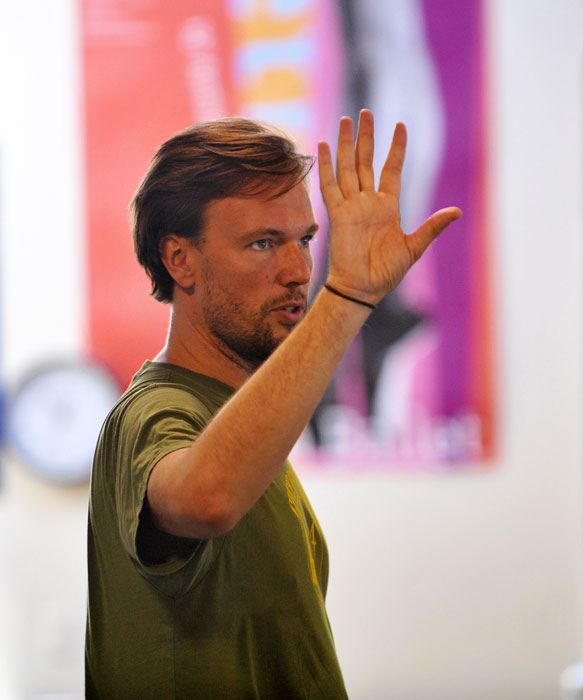
"Mostly breathe, do not punch it," instructs choreographer Helen Pickett from the front of Smuin Ballet's studios, "Listen to the music, do not punch it."
Pickett is in San Francisco rehearsing her ballet "Petal" for the company's spring season, which starts a two-week run this weekend at the Yerba Buena Center for the Arts before touring to Mountain View, Walnut Creek and Carmel.
With a wide smile, she admits to a caffeine-fueled energy as she settles back to watch the dancers launch into her high-octane yet sensual choreography. No delicate hothouse blooms here - "Petal" seems instead to be a barely contained riot of wildflowers.
The vivacious dance maker created "Petal" in 2008 for the Aspen/Santa Fe Ballet, and it's been staged for Atlanta Ballet, where she is resident choreographer. The debut with Smuin Ballet represents a homecoming for Pickett, who lived in San Francisco as a teenager and attended Lowell High School while studying at the San Francisco Ballet School.
While there in 1986, the young dancer met William Forsythe, a choreographer whose lasting influence is detectable in her style. She recalls watching him rehearse the company as he created his ballet "New Sleep."
"After a week of me sitting in the doorway like a 5-year old kid - and this is so Bill - he said, 'You've been watching all this time, why don't you come in and try some things?' " says Pickett, who later asked him if she could audition for the Frankfurt Ballet and joined the company at 19.
"It sounds like a fairy tale, but bottom line is that I asked him," she says pragmatically. "You look at people's lives and they seem charmed, but you are responsible for your success. As Louis Pasteur says, fortune favors the prepared mind."
After several years with Frankfurt Ballet, Pickett left dance to work with the Wooster Group theatrical troupe. She pursued acting for several years, while also teaching Forsythe improvisation techniques, when a chance opportunity from Boston Ballet drew her into choreographing in 2006.
Since then, the lively "Petal" has become one of her best-known works. Pickett says it was inspired by the vibrant color and softness of a Gerber daisy.
"All human beings have these senses, and they connect us," says Pickett, who wrote her master's thesis on proprioception, a word that comes up in her rehearsals. "Intimacy is such an important part of a human life - without it, we wither. So how do we break that fourth wall and connect to the audience more than just visually? Let's celebrate this burst of color, this sound, this touch."
Thursday, November 29, 2012
'The Christmas Ballet' review: Smuin's baby
On Wednesday night, as hula girls daintily strutted to the ukulele strains of "Christmas Island" across the stage of the Mountain View Performing Arts Center - the second stop on the company's holiday minitour that culminates in two weeks at the Yerba Buena Center for the Arts - a guy in the audience murmured, "This is my favorite." And that's the beauty of "The Christmas Ballet": No matter how you feel about the holidays, there's a favorite episode to be found in this show.
Read more: 'The Christmas Ballet' review: Smuin's baby
Wednesday, October 10, 2012
Review: Smuin Ballet season opener
Hougland, who created this piece in 2003 for Louisville Ballet, where he is principal choreographer, is one of a generation of young choreographers whose refreshing vernacular blends balletic form with the heft and universal expressiveness of hieratic gesture. It's a delicate mix that can at times look too studied and academic, but Hougland has a knack for creating a tapestry of inventive movement and evocative shapes that convey the essence of his story without coming off as pedantic.
Read more: Review: Smuin Ballet season opener
Sunday, January 1, 2012
Top 2012 Bay Area dance performances
San Francisco Ballet season (Jan. 26-May 7, War Memorial Opera House, S.F.) Drama and romance converge throughout the San Francisco Ballet season, which kicks off with John Cranko's ravishing "Onegin," based on the Pushkin poem. Beyond the returning classics like "Raymonda," "Romeo and Juliet" and "Don Quixote," SFB's repertory programs promise tantalizing premieres from Mark Morris, Edwaard Liang and Ashley Page as well as Yuri Possokhov's latest - a take on "Francesca da Rimini" - and a long-overdue revival of Balanchine's delightful "Scotch Symphony."Tuesday, September 28, 2010
Interview with Trey McIntyre
Choreographer Trey McIntyre is what you might call an American original. His mix of balletic structures with contemporary flair has a refreshing directness and has made him one of the most in-demand dance-makers of his generation. A Kansas native, McIntyre now makes his home in Boise, Idaho, where his eponymous company, the Trey McIntyre Project, is based.Though he’s made scores of works for companies from Stuttgart Ballet to Houston Ballet to American Ballet Theatre, McIntyre has recently concentrated on creating pieces for his own company. This season however, he’s been coaxed to create a new work, Oh, Inverted World, for Smuin Ballet, and we sat down to talk about his process and his work.
Tell me about the piece that you're working on for Smuin Ballet.
It started off with the music, which is the first album that the Shins produced. I had met James Mercer--who was the singer and principal songwriter for the band--met them back in the day. He and I had talked about maybe working together on a commissioned work, creating music specifically as a dance score. But then things got busy, they got famous, and there was no even getting to them. But it's music I've always responded to. I think it's just brilliant.
What is it about the music that really captures you?
A couple of things. As pop music, structurally and tonally, I think it's very creative and interesting way that he comes at it. The other thing is that with pop music I really tend to ignore words, ignore lyrics, because they're usually silly. But in this case the poetry is gorgeous. I’ll chew on it all day, I’ll think about a line from the piece and really try to get behind it. It’s just so evocative. So in this case, the words matter—not narratively, there’s not a narrative to the piece at all—but there is always definitely a relationship, and it may just be the sounds of the words, the rhythm, the way it rolls off your tongue.
I guess I tend to work with pop music a lot because with certain artists, I take them seriously. I think there’s incredible artists working in that genre. But also, you know, pop music as an American is the soundtrack of one’s life. And it’s not necessarily the storytelling of the music, but – at least I have experienced this—it’s that I associate certain events in my life, there might have been a radio playing in the background or a song that I went to after something happened and there’s a relationship and an emotional content in the presence of the music. So I think that’s why I keep going back in that direction.
Your style is often described as fresh and very American—although I often struggle with that definition of what makes a dance piece “American.” Do you see yourself as a distinctively American choreographer?
I do, for sure.
What do you think that is?I know what it is for myself--as a “movement” I don’t know that that exists right now. Part of it I think has to do with coming from Kansas, because there’s a geographic way of being in space. There’s something about living in the Great Plains where you have a sense of expanse, a sense of groundedness, earnestness. I just remember growing up, relating to people in a way that was so straightforward—you get what you get. And good, there's an essential desire to move toward good, to do the right thing and live with an ethic.
So I feel like, movement-wise I create work that is grounded, of the earth, straightforward. I’m constantly coaching dancers away from acting. Ballet has so much built in that, to me, veers toward sentimental at its core. The incline of the head, certain postures--suddenly it goes to a place that I know is inauthentic when I see a dancer do it.
Like a certain formality to it?
Sure, yes, formality is one part. And also stylization—it’s an affect. I really feel like dance, if it gets right to that seed inside of you, if you can get to that place, it’s true, it comes from an authentic place.
There’s a great Stanislavsky quote from acting training—a concept of teaching really, that basically says “real experiences in imaginary circumstances,” which I think is absolutely what I’m trying to get to with dancers. Because I think as an audience member, in any performing art, I respond to the person on stage– they’re showing me, me. So if it’s an approximation of that, I’m only seeing my worst parts. I’m seeing my false self, my ego-filled self, trying to pretend or be something. As an artist I really want to expose and lay bare. Then I think the product ends up being original because it’s true to who you are—it speaks to some bigger truth.
And so, somehow to me that’s an American quality. I don’t know if everybody sees it that way, but I think that’s just how my upbringing is.
I think that’s why ultimately I’ve gravitated toward a smaller town and Boise, Idaho really supports that. It’s a slower pace of life and it’s very community-minded, you know? We all do this together. If there’s a lot of noise in my life I get distracted very easily.
Now does that balance out, do you ever feel that you’re too far removed from the dance community and what’s going on?
No, (laughs) I feel that I’m just right removed from the dance community. I tend to really avoid the dance community altogether, and at least for me as a choreographer, I think that’s important. I would say this to any young choreographer: see everything, learn from what you love, learn from what you hate. But then, I think you reach a certain point where there’s not anything to be gained by seeing other dance. And I think that with dance, maybe more specifically than anything else, there’s something about watching it—your own muscles fire on some level seeing someone moving, even if it’s tapping your toe--there is a physical reaction to it. So I think you digest what you see in a way that it becomes yours, and then it’s very easy for it to become part of your choreography.
I make a conscious effort to really not see a lot of other work. Just for the very reason that I think there isn’t a true force of American dance right now, at least I don’t think so. I want to go somewhere totally different, I want to go get lost on this path and maybe it’s the right path and maybe it’s not, but at least I want to move towards something new and forward, as opposed to being part of a bigger picture where everyone is moving in the same direction.
Coming back to the piece you’re creating for Smuin Ballet, do you have a title? And how did you come to make this piece now?
Yes, it’s the same as the album, it’s called Oh, Inverted World. I can’t tell you why this album was lodged in the forefront of my mind, but every piece happens like that. I’ll sit on music for a decade, and then all of a sudden, “Today’s the day for this piece,” and that was the case here.
Can you tell me a little bit about it?
I first heard the music when I was in my early thirties, and as somebody who was just entering into a relationship, I was really seduced by this music—I was courted with this music. And I look back at that time, at how I was searching for identity at that period of my life and how powerful music can be in that way and how it can awaken certain things in you. When I first heard this music in my mind this whole world opened up --overnight this possibility of who I wanted to be and what was possible. And not all of it positive—at the time I was abandoning certain parts of myself just because I was so tantalized by this world I had invented.
It makes me think a lot about how we tend to do that as people—we want to be passionate about something without thinking it through. A whole society can move in a direction that way. So I guess, I’m really in the piece exploring those ideas in myself, in some ways creating that fantasy world and also exploring some of the sadness that came along with that at the time, the heartbreak as well.
So is it that you felt that you were choosing a particular identity to become, or choosing something to pin yourself to, or was it more that something presented itself and you just decide that was the track you could take?It was more that latter. And I don’t even know how conscious it was. Part of it was the idea of really being courted so aggressively by somebody in that way was just so tantalizing. Everything about it seemed incredible, but it’s not until that relationship ended that the curtain gets pulled back and all of a sudden you realize, “Oh I really just abandoned myself.”
But I have to say, I don’t know to what extent that’s then what the piece becomes about. Not until the curtain goes up that I say, okay, I see how all those pieces fit together. But those are the things I’m thinking about right now in making the work. You know, I never really understand the work until it’s done. I try to go directly from my own subconscious—I guess getting back to that idea of really getting to what’s most honest. Making choreography to me always feels like the piece is over here already…and if I turn around it’s going to stay behind me, so I’m just trying to get out of the way of it--get my own ego out of the way, my own need to say “I want to make a great piece, I want to impress somebody.”
To what extent does it matter what dancers you’re working with?
Oh, it’s everything. Really. This is the first piece that I’ve made on a company that isn’t Trey McIntyre Project since launching the company full time (in 2008), so it was a big deal. With your own dancers, working with them every single day, the personal advancement has been incredible, I can just keep building and building and building. And that was one of the reasons why I didn’t want to freelance anymore—because I was just so tired of starting over again with new dancers.
And speaking of distraction, I have a very specific way of working--it has to be a very quiet, very focused studio. “Zen” might be even a good word to use. That level of focus is so important to me. I take every nuance seriously in the creation—there’s not a wasted gesture, and so the dancers need to approach it the same way, with great care about what all those details mean. So if there are people that can’t work in that way, I just shut off—switch just shuts off. So I am, and will continue to be very selective about what other companies I’ll work with. It’s very rare that dancers as a group can have that level of sensitivity and focus, and that’s definitely been the case here. It’s been a real joy to work with these dancers.
Choreographing is incredibly vulnerable. I think that personality-wise, I really fell into the wrong profession. I think I’d be a much better painter—you know, just locked away in a room somewhere. I’ve had to acquire the skill of being able to create with people staring at me. It’s not natural to me—I don’t crave being in charge of a room full of people that way. I love the relationship and like finding things within people and helping bring that out. But the level of focus on me is uncomfortable.
So you’re not one of those choreographers who comes in with steps already set and ready to go?
Oh no, no way, not one step. For me it’s been better, the less I can prepare, the better the work is, the more that it’s just absolutely of that moment. Sometimes I’ll even try it--I’ll come up with one phrase the night before and inevitably I will always throw it out. I guess I just really need it to be of that moment—who we are as people reacting to each other. I’ll make a phrase of eight counts and then watch them and see where they go with it, then start to shape it. And then maybe wow, the way she moved her shoulder, I really like that approach, and let’s follow that line. Then it becomes like a tree, branches start to grow off and that’s how the piece comes about. So I’m not looking to them for steps, but it’s collaborative in that I’m finding opportunities in them.
====================
Smuin Ballet performs Oh, Inverted World along with Bluegrass/Slyde and Brahms/Haydn Variations from October 1-9 at the Palace of Fine Arts Theater in SF. The program repeats Feb 4-5, 2011 at the Lesher Center in Walnut Creek and Feb 23-27 at the Mountain View Center for the Performing Arts on the Peninsula. For more information, visit www.smuinballet.org
Photos by David Allen, courtesy of Smuin Ballet.
Monday, May 10, 2010
Smuin Ballet performs Petite Mort, Songs of Mahler and French Twist
For months, I've been looking forward to Smuin Ballet's spring season, which opened at Yerba Buena's Novellus Theater. In fact it started as soon as the company announced that Jiri Kylian's "Petite Mort" would be on the program.Petite Mort. Photo: Scot Goodman)
There's a great move that the couples perform midway through "Petite Mort," in which the men hover over the women's bodies as their partners arch beneath them in a kind of jagged reflection on the floor. The pose itself is one of the memorable moments in this ballet-- a sculptural shape of tension and release that you can appreciate, almost dispassionately, for its abstract beauty. Petite Mort. Photo: Scot Goodman)
Monday, October 5, 2009
Dance Review: Smuin Ballet's "Soon These Two Worlds"
A genuine sweetness pervades Amy Seiwert's carefree new ballet, "Soon These Two Worlds," which Smuin Ballet premiered Friday night at the Palace of Fine Arts.
Perhaps it sounds dismissive to call something "sweet" these days, but Seiwert's latest is a genuinely upbeat diversion that melds solidly structured energy with a fresh, sunny disposition.
Lit with a dusky, afternoon glow by David K.H. Elliott, the six couples have the vibe of companionable friends, perhaps celebrating after a long workday - individuals make their own interpretations of Seiwert's complex steps, but everyone is dancing to the same purpose.
Although there's a hint of African influence in Christine Darch's vibrantly striped tights and skirts - which elicit a pleasant dizziness as the dancers twirl, like watching the slots of a zoetrope go 'round - and an unmistakable African dance flavor to the rounded arm swoops and hip accents, the overall effect of the choreography is 100 percent Seiwert.
Tuesday, May 12, 2009
Dance review: Smuin Ballet opens spring season
In the new/borrowed category is Trey McIntyre’s flirtatious “The Naughty Boy!” which opens the program. Sporting a red furry mohawk of a cap, a pert Jessica Touchet plays a Cupid-like interloper romping through the amorous interludes of four couples. Danced to a recording of Mozart’s Violin Concerto in G, McIntyre’s contemporary speediness is likable, if not ground-breaking, and he maps out his steps with a precision that utilizes deft pointe work and pinpoint accuracy in the partnering to entertaining and sometimes dazzling effect, particularly from the spicy-sweet Jean Michelle Sayeg. But he also misses a few opportunities to steer “The Naughty Boy!” into more unusual territory. When Touchet inserts herself into Erin Yarbrough-Stewart and Aaron Thayer’s romantic pas de deux, for instance, the twining, interlocking trio looks like a promising conceit. But just as things get interesting, Cupid exits, leaving behind a very lovely and sentimental, but garden-variety, duet.
If the praise sounds a mite lukewarm, the problem is that Michael Smuin at his best and most inventive sets a high bar that’s hard to match. Immediately following McIntyre’s ballet on the program is Smuin’s miniature gem “Bouquet,” made for San Francisco Ballet in 1981 and a work that captures the best impulses of the imaginative, evocative ballet choreography of the 1970s. There are nods to the classics in quotations from “Sleeping Beauty’s” famous Rose Adagio and Balanchine’s “Apollo” in the opening quartet, in which a delicate, playful Yarbrough drifts into the sphere of three romantic suitors, but Smuin’s inclination here is toward an unabashed modern romanticism that admirably captures the disquieting ache of Dmitri Shostakovich’s music.
For those more familiar with Smuin’s late period razzle-dazzle, the company also premiered a suite of dances from his last story ballet, “St Louis Woman: A Blues Ballet,” which he choreographed in 2003 for Dance Theatre of Harlem to songs and musical interludes out of Harold Arlen and Johnny Mercer’s 1946 musical of the same title.
The company has edited the original ballet down to suite of dances that sketch the rivalry between jockey Little Augie--played on opening night by the a jazzy, swaggering Ryan Camou--and the owner of Rocking Horse Club, Biglow Brown, danced by Matthew Linzer, both of whom are in love with the same woman, Robin Cornwell’s glamorous Della Green. The results are mixed. On the one hand, we lose bizarre, confusing plot elements like the Death character and the perplexing multiple finale numbers, but on the other, the drama of the races, the shooting and its aftermath are also gone and what remains still doesn’t make a lot of sense. Key numbers like “Come Rain or Come Shine” and “It’s a Woman’s Prerogative”--danced with winning charm by Terez Dean and Shannon Hurlburt-- are still there, as is Tony Walton’s colorful, Matisse-like backdrop. But despite the high-kicking spirit and Broadway jollity, the bits and pieces just doesn’t seem to hang together, although to be fair, neither did the complete original ballet.
An edited version of this review first appeared in the San Francisco Chronicle.
Sunday, November 30, 2008
Dance Review: Smuin's 'Christmas Ballet'
In its 14th outing, Michael Smuin's spiffy, toe-tapping alternative to the avalanche of 'Nutcrackers' retains its lovable verve and still sports loads of eye candy for the anti-snobs of ballet."
Read more on the SF Chronicle site.
Friday, October 24, 2008
Smuin Ballet: Been Through Diamonds, Carmen
It's been a year and a half since the company's highly visible and high-energy founder passed, and time has wrought some changes. Celia Fushille-Burke has assumed the mantle of company director, while dancer Amy Seiwert is now a choreographer-in-residence. Added to the roster this year are dancers Darren Anderson, Ryan Camou, Terez Dean, Ted Keener, Brooke Reynolds, Jean Michelle Sayeg and Shane Messac.
Friday's program opened with a premiere of Seiwert's Been Through Diamonds, a larky neo-classical look at relationships between four couples that found the men clad in loose suit jackets and pants and the women in Mario Alonzo's sexy dresses. With its dark smokiness and mysterious interplay between the sexes, Diamonds has a bit of the look of a much earlier work that Seiwert did for Oakland Ballet in 2003, Monopoly. Whereas Been Through Diamonds is set to Mozart, the music for Monopoly was Gorecki, but in both Seiwert stepped away from movement as abstraction and given her steps a more human backstory and emotional context.
When I saw Monopoly-- which also featured a rock-solid Erin Yarbrough-Stewart, who stood out in Diamonds too-- I recall thinking that something about Seiwert's trademark twisting and fluid style didn't quite jibe with the story at hand and likewise, it's not clear to me that she had found a comfortable way to get her emotional points across while still utilizing the distinctive connectors and thrusts of weight that mark her work.
Still, as more of a meditation, Diamonds made an impression, particularly in the confident way that Seiwert layers complex steps and transitions from one scene to the next. Newcomer Camou made an appealing soloist, as did his partner Susan Roemer.
The other new work on the program was Robert Sund's Carmen, a one act distillation of the famous story of love gone wrong, this time set to tracks from Miles Davis and Gil Evans' Sketches of Spain. Although it seems like the perfect sort of vehicle for a company known for larger-than-life stories, this Carmen came across as less dramatic than angst-ridden.
Aaron Thayer, as the ill-fated Don Jose and Jessica Touchet as his titular lover did their best with the choreography, which offered serviceable, though not always inspired moments. Touchet-- a dancer who sports a bright charm to go with her dead-centered turns--engaged in much teasing and flicking of her shawl and one rather absurdly tame catfight with Yarbrough. She worked hard to serve up sizzle, but it wasn't her fault that ultimately at the moment of highest emotion, she was little more than kicked around.
Also on the program was Michael Smuin's cleverly nostalgic portmanteau ballet Dances with Songs.
Program Notes.
Friday, May 11, 2007
Smuin Ballet: Schubert Scherzo, Romeo & Juliet Balcony Pas de Deux, Falling Up, Carmina Burana
The crowd was oddly quiet, even subdued in the lobby of the Yerba Buena Center for the Arts before the opening of Smuin Ballet’s spring season. Ushers still smiled as they took tickets and handed out programs and old friends still greeted each other warmly but a muted uncertainty hung in the air as audience members took their seats for the company’s first public appearance since the death of their founder on April 23.
Read on the Chronicle site...
Wednesday, April 25, 2007
Dance community grieves for Smuin
The moment was surreal, by all accounts. One minute, the dancers of Smuin Ballet were in high spirits, finishing a quick allegro combination in company class with artistic director Michael Smuin—he was even poking fun at his own choreographic invention. And then, in a flash, he was on the ground and they were struggling in vain to save him.
Throughout the afternoon, as word rippled through the dance community, there was shock at the death of Smuin, who was 68, to an apparent heart attack. In many ways it still seems laughably strange to imagine the Bay Area’s dance landscape without his charismatic, larger-than-life presence. A vital, lively force, Smuin made a buoyant and outspoken ambassador for dance as dancer, director and choreographer, and he had an undeniable impact on how ballet was and is perceived, both locally and internationally.
“It’s a profound loss for all of us, and a personal loss for me that’s indescribable,” said Celia Fushille Burke, who has been Smuin Ballet’s associate director, and now steps into the gap left by his passing. “The outpouring of love has been amazing. I’ve had calls and emails from all over the world. He was very well-loved.”
By chance-- or as some might say, with Smuin’s impeccable sense of timing and showmanship-- the Bay Area’s dance community was already scheduled to gather Monday night for the 2007 Isadora Duncan Dance Awards. Onstage at the Yerba Buena Center for the Arts, Amy Seiwert, along with five other Smuin Ballet dancers appeared to announce his passing and ask for a moment of silence to remember him.
But it was later at the Izzie Awards, during John Kloss’ freewheeling tap performance, that I had a moment of bittersweet memory. Smuin, more than any other major choreographer of the Bay Area’s scene, had a way of capturing the infectious joyousness of dance. And surely somewhere he had to be smiling, because more than any other ballet choreographer he understood the appeal of a good-looking guy dancing and humming along to his own inner music.
Like so many of his generation the Montana-born Smuin fell in love with ballet through the Ballets Russes. Spotted by San Francisco Ballet director Lew Christensen at the age of 15, he joined the company in 1953. It was at SFB that he would meet and marry fellow dancer Paula Tracy, with whom he had a son, Shane. And in 1973, he returned to co-direct the company with Christensen, overseeing the PBS broadcasts of his “Romeo and Juliet” and “The Tempest,” both of which won Emmy awards.
A gifted character dancer and ebullient raconteur, Michael Smuin brought his zest for telling a story as well as a mischievous sense of humor to his choreography. From his 1968 “Pulcinella Variations” to last year’s zesty “Obrigado, Brazil” Smuin’s ballets were wonderful fun. If they didn’t leave a mark with the intellectual crowd, nevertheless, you couldn’t deny that his were well-made, and entertaining dances. His fault, if it could be called that, was that he was always so eager to give that sometimes he went over the top.
Serious ballets like “Medea” highlighted the dancers’ dramatic abilities, but even small vignettes such as “The Last Song” in his Elton John-inspired “Come Dance Me a Song” offered a special poignancy. Smuin’s romantic adagios, particularly his pas de deux such as “Romanze” or “Bouquet,” remain achingly beautiful. Balletomanes who came of age in the 70s have searing memories of American Ballet Theatre stars Cynthia Gregory and Ivan Nagy in “Eternal Idol,” or Diana Weber being swept off her feet by Jim Sohm in “Romeo and Juliet.”
“He was the turning point for San Francisco Ballet,” says former SFB principal dancer Evelyn Cisneros, who joined the ballet under his direction in 1976 and retired in 1999.
Reached by phone in Southern California, Cisneros recalled Smuin as “a gifted and artistic presence. He was the beginning of a new era for the company and he helped bring it back to international status through his commitment and determination and energy.”
And yet, he never forgot the small things, or forgot what his dancers brought to his work. As a young apprentice, one of Cisneros’ earliest memories of Smuin was from the morning after the premiere of “Songs of Mahler.”
“He came into the studio before class and he went to each of the women who had been in the ballet and gave each one a flower,” she recalls, “and it so touched me to watch that.”
Unlike the stereotypical ballet director, Smuin loved for his dancers to have a life outside of the studio-- to have families and their own projects.
“One thing that set Michael apart from all the others was the love that he has for the individual,” Cisneros said emphatically, “He never saw a dancer as someone to mold – he wanted you to be the person you were. I think that’s why dancers loved working with him, you felt artistically enriched because he asked you to bring who you were to the dancing.”
After his infamous parting of ways with San Francisco Ballet in 1985, the endlessly energetic Smuin picked his dancing shoes up and moved onto a wide variety of projects, including his 1988 Tony Award-winning version of “Anything Goes” on Broadway.
“If there’s one thing he taught me,” Cisneros says, paraphrasing Ralph Waldo Emerson, “It’s this: It’s not what is before us, or behind us, but what is within us that matters.”
In 1994, he founded his own fledgling company --Smuin Ballets/SF, later Smuin Ballet – and created new work at a prolific pace, usually two or three ballets a year.
With a brazenly theatrical flair and canny professional instincts, he coaxed in audience members who had never before even considered going to a show that had the word “ballet” attached to it. Ever the entertainer, Smuin put his dancers into new unexpected places—dancing the national anthem at a Giants game in PacBell Park, slithering through the remixed cantina scene in “Star Wars,” at the Macy’s Passport benefit.
There were no stick-figure ballerinas for his company, where the women are sexy and the men bold. The stories he wove through his dances were about real people, and starred real people. It was a winning formula that appealed to audiences who made the company arguably the most consistently popular small dance troupe in the Bay Area.
As with any loss of this kind, the road ahead for Smuin Ballet is difficult to imagine without its charismatic founder and auteur. Nevertheless, Smuin was nothing if not the consummate theater professional, and the organization he built will have no trouble standing on its own legs with Fushille-Burke and newly-arrived Managing Director Dwight Hutton, at the helm.
On Tuesday morning, at the insistence of the dancers, there was company class-- as there is every day --at 9:30 a.m. Fushille-Burke, who was out of town on Monday, flew back that night to be with the company. “We will go on,” she said early Tuesday. “That’s what Michael would want and that’s what he did want.”
Smuin’s final work-- set to the Scherzo of Franz Schubert’s Great C Major Symphony-- was mainly completed, and the company will premiere it during their May seasons at the Yerba Buena Center for the Arts and at the Lesher Center among other venues. Smuin Ballet still plans to tour to the Joyce Theater in New York in August.
And yet, even as they move forward, one can’t help but feel the hole left behind by the buoyant, forthright presence of the man who so loved dance, but even more, so loved to bring dance to anyone and everyone.
This article first appeared in the Contra Costa Times.
Friday, November 24, 2006
Dance Column: Holiday Treats
ODC/Dance’s “The Velveteen Rabbit”
Why do I love “The Velveteen Rabbit” so much? Is it because I’m a sucker for hard luck cases? Possibly. I get farklempt at the mere description of the threadbare, velveteen fur and shabby velvet nose.
KT Nelson’s take on the tale of the “bunchy, fat bunny” and the boy who loves him has become an enduring holiday tradition, and justly so. This year marks the 20th anniversary of the enormously popular “The Velveteen Rabbit,” and a host of special guests will be on hand throughout ODC/Dance’s run to help celebrate. Among the events this weekend, Friday’s matinee (November 24) is Grandparent’s Day, Saturday (Nov 25) is ASL Signed Narration Day with actor Ty Giordano, and Sunday’s matinee (Nov 26) will be followed by a milk and cookies party with the dancers (Call the Yerba Buena box office for tickets to the party.)
And as always, plan to bring your stuffed animal friends along to enjoy the show. Don’t they deserve a night out too?
ODC/Dance performs Margery William’s beloved classic November 24 – December 10 at the Yerba Buena Center for the Arts in San Francisco. (www.ybca.org, 415-978-2787)
Smuin Ballet “Christmas Ballet”
Fans of Michael Smuin’s holiday revue are in for a treat this year as the Smuin Ballet adds seven new numbers to the lineup, including three by Michael Smuin, two contributions from associate director Celia Fushille-Burke, and one apiece from Amy Seiwert and Shannon Hurlburt. With newly refreshed sets and costumes, this Christmas buffet, which comes in hot and cool versions, puts a sassy spin on the Christmas roundelay.
The 2006 edition of the “Christmas Ballet” makes its bow on the stage of the Dean Lesher Regional Center for the Arts November 24-25. Or you can catch it at the Yerba Buena Center for the Arts from December 15-24. (www.smuinballet.org, 925-943-SHOW or 415-978-2787)
Moving Arts Dance Company’s “MAD Hatter” Performance and Tea Party
For something a little more unusual, follow Alice’s granddaughter Allyson down the rabbit hole at Moving Arts Dance Company’s second annual “MAD Hatter” Performance and Tea Party. There are sweets aplenty on the table and on the stage as choreographers Anandha Ray, Michael Lowe, Dudley Brooks, Jenny McAllister, Dianna Rowley, and Isabelle Sjahsam offer up their version of life in Wonderland.
Moving Arts will have two shows in San Francisco at the Cowell Theater on December 2 (www.fortmason.org, 415-345-7575) and two shows at the beautiful El Campinil Theatre in Antioch on December 9 (www.elcampaniltheatre.com, 925-757-9500).
Diablo Ballet’s “Nutcracker”
In collaboration with Civic Arts Education, Diablo Ballet will unveil its very first production of the “Nutcracker” at the Del Valle Theater in Walnut Creek. Directed by the Diablo Ballet Intermediate Program’s Rebecca Crowell, the production won’t lack for talent. Leading the cast of 58 dancers – which includes children and adult drawn from all over the East Bay, as well as the Diablo Ballet apprentices – will be Tina Kay Bohnstedt and Vikot Kabaniaev as the Sugar Plum Fairy and her Cavalier. Lauren Main de Lucia and Matthew Linzer will rule over the Land of Snow, and Nikolai Kabaniaev, Diablo’s co-artistic director, will even take his turn onstage as Herr Drosselmeyer.
Diablo Ballet’s “Nutcracker” premieres at the Del Valle Theatre in Walnut Creek, December 1-3. (www.diabloballet.org, 925-943-SHOW)
San Francisco Ballet “Nutcracker”
The gold standard of "Nutcrackers” around here has always been the San Francisco Ballet production and Helgi Tomasson’s grand version, with its spectacular, larger-than-life sets and costumes holds delights for kids of any age. With dreamy scenes and even dreamier dancing, this “Nutcracker” is sure to send patrons, young and old, twirling out into the streets.
At the regular family performances, there’s milk and cookies in the lobby, plus, SFB also offers a chance to give a little holiday delight with the annual San Francisco Firefighters Toy Drive. Bring along a new toy or book to donate when you come to the show and the SF Firefighters will see that it brightens a needy child’s Christmas.
San Francisco Ballet’s “Nutcracker” runs December 14-31 at the War Memorial Opera House in San Francisco. (www.sfballet.org, 415-865-2000).
Contra Costa Ballet "Story of the Nutcracker"
For an early start on the holiday season, you can see the Contra Costa Ballet’s "Story of the Nutcracker," an hour-long version of the ballet, which features Diablo Ballet’s David Fonnegra and Company C’s Jenna Maul as the Sugar Plum Fairy and her Cavalier.
The Contra Costa Ballet performs their version of the holiday classic from November 30-December 2 at the Dean Lesher Regional Center for the Arts in the Hofmann Theater. (www.contracostaballet.org, 925-943-SHOW).
Berkeley Ballet “Nutcracker”
Teacher, choreographer, director, Sally Streets has been a mainstay of the Bay Area ballet scene, and this year the company she founded, Berkeley Ballet Theater, celebrates its 25th anniversary. Streets and Robert Nichols choreographed this colorful and lovely version of the Tchaikovsky classic to make a more intimate experience.
To kick off their anniversary season, they’ll be performing their production of the “Nutcracker” from December 8-17 at the Julia Morgan Theater in Berkeley. (www.berkeleyballet.org, 510-843-4689)
Smuin Ballet: Christmas Ballet 2006 edition
“The Christmas Ballet” 2006 Edition
Yerba Buena Center for the Arts
December 15-24, 2006
The post-Thanksgiving crowd at the Lesher Center showed no tryptophan drowsiness at the opening of Michael Smuin’s annual favorite, “The Christmas Ballet,” which made its bow last weekend with spiffed up new costumes by Sandra Woodall and newly designed scenery by Douglas Schmidt and Paul Swensen.
Smuin’s flagship productions are usually elaborate affairs, and this year’s refurbishment of the company’s holiday staple actually benefits from having more sparkles and fringe. In the first half, new white drapery suggests an elegant ballroom with outsized lacy snowflakes hovering overhead, while the second half is bathed in yards of Christmas crimson velvet, punctuated by dozens of fluffy, white, beachball-sized “Santa cap” pom-poms.
Admittedly, the designers have gone a little projection-happy, in the second act particularly, where video of everything from church bells to mistletoe only distract from the dancing. Still, all the new flash and dash does help create some truly lovely images. In the opening to the second act, “Christmas by the Bay,” the dancers now dip and swirl behind projections of San Francisco holiday scenes, and the simplest images -- the lights of Union Square’s Christmas tree or the outlines of the Embarcadero Center -- make a romantic frame around the five couples.
The high-flying company is also still getting used to the low-flying snowflakes. During an excerpt from Handel’s “Messiah,” Ikolo Griffin tossed his partner so vigorously that her head bonked into one of the snowflakes, causing some mirth in the audience.
If the company took a little time to warm to their work in the opening “Magnificat,” by the second piece -- “Noel Nouvelet,” Amy Seiwert’s contribution to this year’s edition -- Aaron Thayer and Erin Yarbrough make a ____ couple. Seiwert gives them simple, and yet unexpectedly lovely choreography – mere pirouettes facing in opposite directions are effective because they fit to the music beautifully.
The look of the women in the company has gradually been shifting towards more of the bullet-like, compact zingers like Vanessa Thiessen, who stood out in the “Zither Carol” and “Away in a Manger.” In “For Unto Us a Child is Born” Yarbrough, partnered with James Strong, evinces the same speedy, knife-like technique along with a regal, classical upper torso, but when she lets her hair down, as she does in “What Are You Doing New Year’s Eve?” – a sweetly romantic diversion contributed by Shannon Hurlburt -- the sex appeal is palpable. As always, Strong proves himself a more-than-just-reliable squire, particularly in “Hodie Christus Natus Est” which he danced on Friday night with Thiessen. Her light jumps and intent confidence gave the couple an illusion of breathlessness, but when certain lifts proved difficult to manage, it was Strong who kept the duet moving.
The company will always need its long and leggy dancers though. Nicole Trerise makes a luscious comedienne in “Licht Bensh’n” and the ever popular “Santa Baby,” which had the audience clapping from the first “ba-boom.” She shows off a more serious side paired with Thayer and two other couples in Celia Fushille-Burke’s “Es ist Ein Ros Entsprungen.” The graceful refinement of Fushille-Burke’s choreography for the three couples has all the hallmarks of her own dancing. The footwork for this section, as well as for her “Resonet in Laudibus,” which immediately followed, offered deceptively pretty, and yet tricky combinations -- of the sort that Fushille-Burke herself always navigated with aplomb.
Jessica Touchet shows off formidable baton-twirling skills in the oddly gimmicky “Carol of the Bells,” which Smuin created for her this year, while Hurlburt, always a favorite, reprises his signature showstopper roles in “Little Drummer Boy” and the dazzling tap solo to “Bells of Dublin,” as well as his usual solid yeoman work throughout the evening.
And though it’s often the new dancers -- like Griffin, Courtney Hellebuyck, and Yoko Callegari, who just joined the company this month – who receive notice, there’s a definite pleasure in watching others like Aaron Thayer improve year by year. Thayer’s solo -- a new section created by Smuin to a recording of Placido Domingo singing “La Virgen Lava Panales”-- has a mature conviction and vitality, and in “Pretty Paper” a duet with Robin Cornwall, he hits just the right balance of playful solicitude.
In the end, this year’s edition of “The Christmas Ballet” is jam-packed with 28 bite-sized numbers. Some of them are cheeseball, some quite lovely, but all adding up to a jolly way to start the season.
This review originally appeared in the Contra Costa Times.
Saturday, February 11, 2006
Smuin Ballet: Bluegrass/Slyde
“Bluegrass/Slyde,” “Romanze,” “The Eyes That Gently Touch,” “To the Beatles”
Dean Lesher Regional Center for the Arts
February 11, 2006
It’s possible that on hearing that Michael Smuin’s latest work, “Bluegrass/Slyde” involves dancing with poles, your eyebrows went up at the thought -- but rest assured, it’s a better concept than you might think.
Set to the Appalachian-inspired compositions of bassist Edgar Meyer – as well pieces by the uncredited virtuoso banjo-player Bela Fleck, fiddler Mark O’Connor, and James Taylor -- “Bluegrass/Slyde” saw Smuin Ballet taking a pleasantly athletic turn on the stage at the Dean Lesher Regional Center for the Arts.
The fire-engine red set, built by James Beaumont, has the look of a rock band rig, with three poles arranged across the middle of the contraption. The poles themselves revolve smoothly, and with a small step attached to the bottom, the dancers can jump on and spin like kids in a playground or fly through the air and grab onto the poles, swinging around à la Spiderman, or at least Gene Kelly.
The effect is compelling and gives the dancers a kind of ice skater speed along with an unusual flow of movement. The laconic swizzling perfectly fits the bass and slide-banjo twang and the dancers look like they’re enjoying the sailing through the air, particularly Ethan White who brings a genuine energy and zest to the task.
“Bluegrass/Slyde” isn’t a perfect piece. Once the novelty of the convention wears off, it’s hard not to notice that there’s an awful lot of running onstage. A tap number to “Limerock” doesn’t have quite the clarity it enjoyed when the piece premiered in San Francisco last September. And the sections choreographed for pointe work -- which look overly classical – make it apparent that, for this piece, the women are far more comfortable and rangy when they’re in soft jazz shoes and grounded.
Still, Smuin is at his best in a lazy diversion for three couples to O’Connor’s “Misty Moonlight Waltz.” Amy Seiwert and White deftly set up the mood within a few minutes, with White floating compellingly over her head as they spin lazily around the center pole, a picture of mellow romance.
“Romanze,” which followed on the program, remains one of Smuin’s loveliest small vignettes, and one of his most imaginative creations. Inspired by a Victorian diary that detailed a real and a fantasy day in the life of a young couple, it’s a clever blend of dance with film. The “real life” portion, supplied by Francis Ford Coppola’s film of Catherine Batcheller and Alexander Topciy (the original dancers at San Francisco Ballet) is shown on a scrim, through which we watch their inner passions unfold as danced by Easton Smith and Celia Fushille-Burke. As the screen image zooms in on a grassy meadow or ocean shore or a flower, the dancers appear through the projection seemingly floating through the visual space.
Though some of the choreography looked spatially compressed, as if the dancers themselves felt a bit limited despite the sweep of Antonin Dvorak’s music, it was a pleasure to see Smith, who returns to the company this season from Sacramento Ballet, and who has found a lengthened line, refinement and more confidence.
That kind of fully realized concept was missing from “The Eyes That Gently Touch,” a work choreographed by Kirk Peterson for three couples to the music of Philip Glass, which was pretty, but less left impact. Despite a flowing style with striking abstract sculptural qualities, on the whole, the ballet looked safe, both in its conception and execution.
Also on the program, which seemed a bit lengthy, was Smuin’s 2001 “To the Beatles, Revisited,” in a revised form that included only 11 sections. To judge by the costumes – by Sandra Woodall -- and steps, which included moonwalks and breaking moves to Fab Four favorites like “Help!” and “Sergeant Pepper’s Lonely Hearts Club Band,” the ballet seems set in the era of 80s nostalgia for the 60s. Still, there was a sense of fun that cut through some cheesiness, and the stellar Benjamin Stewart, who joined the company this year from Atlanta Ballet, dove into numbers like “Day Tripper” and “Come Together” with intelligence to match his good-natured energy.
This review originally appeared in the Contra Costa Times.