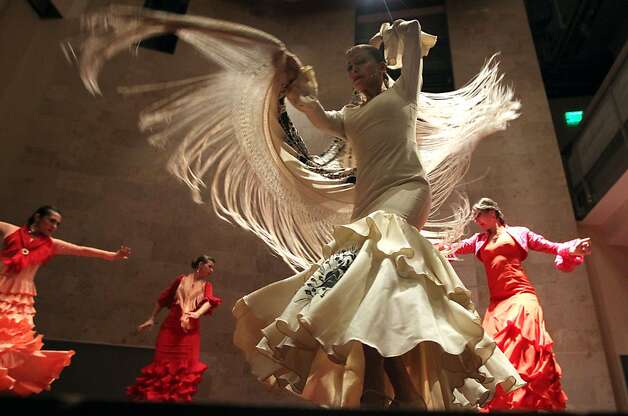
Showing posts with label flamenco. Show all posts

Sunday, February 10, 2013

Flamenco, Spanish poet intersect in opera

Spanish poet Federico Garcia Lorca wrote: "I know there is no straight road/ No straight road in this world/ Only a giant labyrinth/ Of intersecting crossroads."

Lives twine and intersect in richly imagined episodes of byzantine complexity in Osvaldo Golijov's opera "Ainadamar," which Opera Parallele, under Nicole Paiement's direction, performs this weekend at the Yerba Buena Center's Lam Research Theater.

Read More: Flamenco, Spanish poet intersect in opera

Sunday, December 30, 2012

Best of dance in 2012

High: "Onegin" at San Francisco Ballet: John Cranko's ravishing "Onegin" inspired not only luscious dancing but also transformative performances of enormous dramatic depth, from the corps to the principal and across four casts of dancers at San Francisco Ballet. Everywhere you looked onstage, the dancing transcended mere steps, confirming yet again that this is a ballet that has the power not only to change the way you think about artists you've watched for years, but also to change the way you see dance forever.

Low: The ousting of Dennis Nahat at Ballet San Jose: In a split that was as unpleasant as it was confounding, in January, Ballet San Jose's board abruptly removed Dennis Nahat as artistic director of the company he founded, while commencing a partnership with American Ballet Theatre. After a shakeup in the ranks, and a precipitous reorganization of artistic leadership, the company seems to have regained some of its footing. But while no one disputes that change is part of the artistic life of any organization, it didn't have to happen this way.

Most improved: Emerging Pictures' "Ballet in Cinema": In times past, balletomanes resorted to secretly traded, shaky and shady videotapes if they wanted to savor the Bolshoi performing "The Bright Stream" or catch a glimpse of the Nederlands Dans Theatre in between infrequent U.S. tours. Now "Ballet in Cinema" has made it possible to see everything from the Royal Ballet's latest "Swan Lake" to Martha Clarke works at La Scala, right in the comfort of your own neighborhood movie theater. Of course, nothing beats seeing live performance, but if a jaunt to the great theaters of Europe isn't in your immediate future, this comes close.

MVP: San Francisco Ethnic Dance Festival: Hundreds of world dance performing troupes and organizations make their home in the Bay Area, and for 34 years the San Francisco Ethnic Dance Festival has brought that enormous diversity of dance to the stage - Indian bharatanatyam, Brazilian capoeira, West African dance, Argentine folklórico, Appalachian clogging, flamenco, Celtic dance - the list is both dazzling and exhaustive. Whether the troupe is earthy or airy, traditional or avant-garde, the Ethnic Dance Festival creates a milieu in which Chinese lion dances can coexist with Ewe warrior dances from Ghana while offering a lens on the human experience that can be thrilling, touching, informative and entertaining, often all in the same evening.

Top 10

Los Farruco: (Bay Area Flamenco Festival, Sept. 30). Every performance of Los Farruco feels like flamenco as it should be - low on frills and furbelows but high on octane and electric in its execution.

"Swan Lake": (Mariinsky Ballet, Cal Performances, Oct. 10). The iconic Mariinsky proved once again that true beauty in classical ballet is found not only in the elegant details but also the meticulous and loving attention to tradition.

Clas/Sick Hip Hop Festival: (Dec. 1) Marc Bauthi Joseph's brilliant informal format put the audience on the same floor with icons of hip-hop, and when you saw the look of inspiration in the eyes of the younger dancers crowded around the feet of Nonstop and I Dummy, admiring, analyzing and absorbing dance, suddenly it felt as if theatrical dance had fresh relevance to a new generation.

Renee Robinson performing with Alvin Ailey: (Alvin Ailey American Dance Theater, Cal Performances, March 17) We didn't know it then, but it was the last time the Bay Area would see Renee Robinson in her iconic yellow dress rocking our souls in Alvin Ailey's joyous "Revelations." The inimitable Robinson, who retired in December after 31 years with the company, spread her infectious enthusiasm like a gospel, and we were her willing acolytes.

Boy Blue's "Emancipation of Expressionism": (San Francisco International Hip Hop DanceFest, Nov. 18) Hip-hop at its most expressive took on the inexorable momentum of a freight train when London's Boy Blue performed at the hip-hop festival crackling with adrenaline, barely reined in by mathematical precision.

Katherine Wells in "Helen": (Robert Moses' Kin, March 30) Was Robert Moses creating a tribute to an unforgettable woman? The remarkable Katherine Wells was mesmerizing, seductive and authoritative - a dancer that you can't stop watching, no matter what she's doing or where she is onstage. KT Nelson's "Transit": (ODC Dancing Downtown, March 17) Max Chen's quirky and inventive sculptures only added to the velocity and dynamic range of KT Nelson's wistful portrait of the pulse and hum of urban life.

"Constellation": (Lines Ballet, Oct. 19) The stars aligned in one of Alonzo King's most satisfying and playful works, an array of thrilling and kinetic dance framed by Jim Campbell's innovative LED light designs.

Ohad Naharin's "Max": (Batsheva Dance Company, San Francisco Performances, Feb. 23) Ohad Naharin's visceral Gaga technique and its interplay of muscle and bone was surprisingly compelling in a display that was as inviting as it was ritualistic.

"Tarantella": (Diablo Ballet, May 5) Robert Dekkers soared in lofty jumps and Hiromi Yamazaki flirted with intricate pointe work - together they brought to the notoriously tricky "Tarantella" a glamour and delightful vivacity - and a sense of fun too rarely seen in Balanchine's works.

Read more: Best of dance in 2012 

Sunday, September 23, 2012

Flamenco a way of life for Los Farruco

Stormy, soulful, inspired, extemporaneous and often temperamental, flamenco gitano or gypsy flamenco is considered by some to be the highest form of the art. To see flamenco puro is to experience more than just a performance - it is an entree into a conversation in which the singers, the musicians and the dancers have myriad sentiments and convictions to share - with each other, with us and with a higher power.

"Gypsy flamenco is very much a real transmission of emotion and the culture that they live and breathe," says Nina Menendez, the organizer of the Bay Area Flamenco Festival, which begins Monday.

Read more: Flamenco a way of life for Los Farruco 

Wednesday, March 14, 2012

Ballet Flamenco: Troupe's fresh take on tradition

"I prefer to say we are blending rather than creating a fusion," declares Carolina Lugo, the vivacious dancer and leader of Ballet Flamenco, which premieres "Alas del Tiempo" ("Wings of Time") this weekend. "I think the word 'fusion' is overused."

Call it what you will, the brand of modern flamenco that Lugo and her daughter Carole Acuna have brought to stages around the Bay Area has a potent energy, whether it finds its roots in the Moorish hues of Granada or the pulsing samba cadences of Brazil.

"All those rhythms and melodies are a part of flamenco because Gypsies traveled through so many different countries," Lugo explains, "and blending those is a more apropos term for what we try to do."

Ballet Flamenco: Troupe's fresh take on tradition

Monday, March 16, 2009

Dance Review: Los Farruco at the Palace of Fine Arts

Los Farruco's stunning one-night-only show at the Festival of Flamenco Arts and Traditions at the Palace of Fine Arts Theater on March 6 had to have been one of the Bay Area flamenco community's most highly anticipated performances. So I was surprised in the week after to find out that so few people outside of the flamenco circles even knew that the family Farruco was even performing -- how did it not register on the mainstream dance community's radar?

Even so, pesented by the Bay Area Flamenco Partnership, Los Farruco easily sold the Palace of Fine Arts theater out. The lobby was jammed, and even a last minute snafu with the online ticketing service didn't deter patrons, who waited forty-five minutes for the show to start under chaotic circumstances to say the least. But then, we are talking about one of the world's leading exponents of flamenco puro, and a family of artists descended from the legendary El Farruco, whose grandson Farruquito seared his presence onto the stage at the Flamenco Festival USA with Juana Amaya back in 2003.

Perhaps anticipation of the family's tour was fanned by the release of the 2005 film "Bodas de Gloria," which chronicles the lives of a gypsy clan, in a sort of retort to the violent panache of "Blood Wedding." Farruquito--Juan Manuel Fernandez Montoya, who did not appear on this tour, but apparently helped to produce it-- stars in the drama which was filmed back in 1996, but of equal note were the appearances by El Farruco's daughters, Rosario Montoya "La Farruca" (Farruquito's mother) and Pilar Montoya "La Faraona" and the debut of young Antonio Fernandez Montoya, Farruquito's younger brother, who would take on the name "El Farruco" after his grandfather's death in 1997. These three, La Farruca, La Faraona and El Farruco the younger were joined by La Faraona's son "El Barullo," for an electrifying evening.

If all of that seems confusing, perhaps it's enough to understand that this was a family affair, and that for a few hours, it felt as though you'd been invited into the Farruco family for a glimpse of what life looks like in the eye of the surging storm that their intensity whips up. The show is still a show--this is entertainment of the first-order, but beyond that, it feels personal. These musicains and dancers have something to say--to each other, to us, to a higher power. They have the tools to put that conversation across, and nothing is so satisfying as being a part of that, whether you're onstage or not.

A smoky air hangs over the stage when the curtain finally goes up to reveal guitarist Antonio Rey Navas alone on the stage, playing in cascading ebbs and flows to a theater so silent and rapt that under the strains of a solo you could hear him taking breaths.

But it isn't long before the guys, Barullo and Farruco burst onto stage, roiling with youthful vigor. Clad in simple black pants, a white shirt and red scarf at the throat, they face off, attacking the ground, attacking the music, and you think to yourself, ah the energy of youth. Then La Farruca arrives.

For a moment, the boys look as though they're daring her to take them on... poor mama. Then she unleashes an unsuspected fury...poor boys. La Farruca has a wild feral quality, a tempestuousness, that takes her fearlessly off balance, and yet which she completely controls. In about two minutes her hair is out of a neat chignon and the energy coursing from the singers to the dancers and back is palpable, like an electric current -- you can't take your finger out of the socket.

With the audience still breathing hard after that last encounter, Rey returns, this time accompanying the singers (Antonio Zuniga, Simon de Malaga, Mara Rey and Pedro el Granaino), and the rasp of brings back to me the images of a singer in Granada leaning off an iron balcony above a crowd of hundreds, singing to the Virgin during Holy Week.

The terrifically commanding Mara Rey leads the entrance of a rotund woman with a capacious bosom covered in red silk for the bulerias. Faraona is a force to be reckoned with, even with a bandage on her hand and the audience goes crazy as though we're imploring her to dance, literally shrieking for her to continue.

As Barullo returns, in a rust-colored suit with a long jacket that he flourishes like a shawl, for his Seguiriya, the shouts begin anew. He turns so impossibly off balance that it nearly looks like acrobatics, but from the audience, a woman shouts in Spanish, and the only word I make out is "duende." In response, a faint smile turns up the corner of Barrullo's lips as he rips off the jacket and gets busy charging into ridiculously complex rhythms.

Mercurially, the mood changes again for Farruco's solea and he enters upstage like a shadowy ghost behind the cantaor. Tall and slender, he takes his time, hands capturing the air, moving slowly with sturm und drang washing all around him. Then suddenly, he is like a man unleashed on life, with lustiness and perhap even petulance coming out in lightning blasts of zapateado.

La Farruca returns for the romanza, cutting a stunning silhouette in a long dark dress. With just the hands curled into fists, and her long hair continually escaping its bounds, she looks possessed. She gets all up into the singers' grille, inspires extra energy from them and in a display of dictatorial pique, stomps the ground with a force that conveys a temperament that is at once inexorable and inextinguishable.

As the jaleos draw to a close, the family Farruco takes their bows but fromthe mood of the crowd on its feet and stomping themselves, it can't be over. For an encore, the musicians, singers and dancers all come out onto the apron of the stage and Farruco rips a chair free from its microphone wires and sets it downstage for guitarists Rey and El Tuto to lean on. Now is the time for everyone to dance, even their lighting designer comes out in sneakers and takes a turn with them. Nobody leaves without dancing.