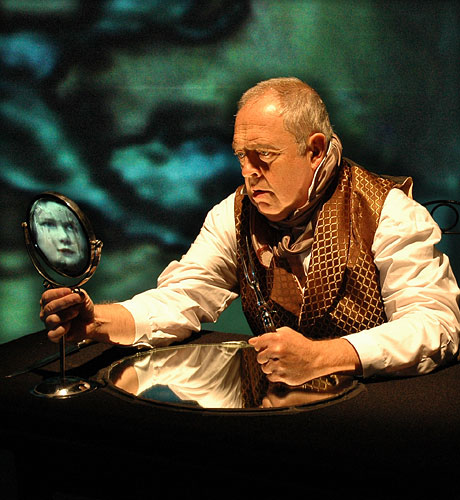
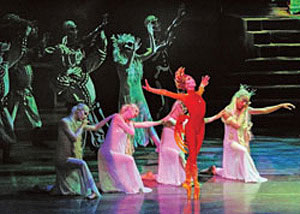
First up is "Dottie's Magic Pockets," the brainchild of Tammy Stoner and Pink Pea Productions, which is designed not just to be gay- and lesbian-friendly, but also to feed a growing appetite for programming that introduces kids to the modern world's broad family range.
Thursday, June 19, 2008
Family films at Frameline32
Monday, June 9, 2008
Dance Review: Joe Goode Performance Group-Remember the Wonder...
As in "Christmas Ride," the style reflects a modern version of the Japanese bunraku puppet form, in which the operators of the puppet are not only visible to the audience, but play characters of their own. In a strange way, the parsing of Goode's choreography, with slightly self-conscious, inward-seeking movements, makes an excellent match with the range of motion available to the boy himself.
In fact, the dancers (Melecio Estrella, Mark Stuver, Jessica Swanson, Andrew Ward, Patricia West and Alexander Zendzian) have obviously lavished attention not only on their own solos and duets, but also on matching their movement to Wonderboy's choreographed phrases. Perhaps though, there is no one better suited to this danced bunraku style than movement professionals. Accustomed to working in partnership and projecting the lines beyond their own bodies, the human performers generously transfer "realness" to this latter-day Pinocchio.
But making "realness" is also Basil Twist's stock in trade. A master puppeteer, who can seemingly enable any object--puppet or not--tell its own story, Twist imbues his boy with endearing details, an enigmatic lift to the corner of his lips, a sparkle in his eye, that continually draw your attention back to him.
As Wonderboy observed and commented on the workings of the world from his spare metal window frame-- just as the audience was watching from outside our own proscenium/window-- I couldn't help marveling at the enormous empathy I felt for the little guy. When he left the stage, I was a little unnerved and disappointed, like a kid whose friend has moved away, and when he tentatively dips his foot into the flow of life, I sensed a rush of exhilaration at his jetes from place to place. If only we could have flown up the aisle with him at the end.
Visit joegoode.org for more information on the show.
Thursday, May 22, 2008
Mission to Mars at Chabot Center
Chabot will be throwing a landing party sure to spark the imaginations of anyone who's ever wondered about life on Mars. Over three days, visitors can follow the progress of the 1,500-pound Phoenix spacecraft as this first entrant in NASA's Mars Scout program completes its 422 million-mile journey, and - in just seven tense minutes - decelerates from its 12,500-mph plunge toward Mars to, it is hoped, gently land on its own three feet Sunday afternoon.
Sunday, May 18, 2008
Global perspective at S.F. Arts Festival
Wednesday, May 14, 2008
SFB School: Room, board and barre for Ballet students
As any artist knows, the road to professional success isn't easy. For many of the youngsters who win the opportunity to train at San Francisco Ballet's School, the pursuit of a career in the notoriously competitive world of ballet means sacrificing, not only time and energy, but family life as well. Students come from across the country and around the world to study at the school, but for a young dancer of perhaps 16 or 17, the task of finding a place to live in San Francisco is no trivial matter.
Monday, May 12, 2008
Earthquake in China
It shows up starkly as a giant block the size of, oh say, New Mexico, in the USGS' World Earthquake Map.
I was amazed to find out that NPR reporters Robert Siegel and Melissa Block happened to be in Chengdu on Monday recording shows for All Things Considered. Talk about wacky timing. Listen to Melissa Block, who was rolling tape at the time of the earthquake.
Saturday, May 3, 2008
Dance review: Nahat adds twists to 'Firebird'
Nahat's 2005 version, which opened at the San Jose Center for the Performing Arts on Thursday night, makes minor changes to the original tale, inexplicably changing the name of the Russian folk hero Ivan Tsarevitch to Prince Vladimir, for example. But for the most part, Igor Stravinsky's luxurious score - here a recording of his original 1910 version of "The Firebird" - dictates much of the story line, a conflation of Russian folk legends about the young son of a czar who rescues a princess from the clutches of the demon Kastchei with the help of a magical Firebird.
Saturday, April 26, 2008
Dance review: 'C(H)ord' hard to forget
Like most of the 10-year-old inkBoat's butoh-inspired theater, "c(H)ord" - a commission for YBCA's Making Peace series - is hardly literal or linear. Boasting an international cast - which includes Finnish performer Heini Nukari as well as the Japanese Takuya Ishide, Yuko Kaseki and Sten Rudstrøm (both based in Berlin) and Sherwood Chen, Dana Iova-Koga and Dohee Lee - it's the sort of show where you can't seriously ask yourself what just happened. The pleasure lies in allowing its vagaries to cascade past you episodically, and the overall effect is not so much discomfiting as strangely charming.
Read more on the SF Chronicle site.
Tuesday, April 15, 2008
SF Symphony's Adventures in Music program
Eng puts on a CD and Saint-Saëns' Algerian Suite thumps mildly in the background amid the chatter of young voices. While the girls continue embellishing the neck of their snare guitar with flames that would make Ted Nugent proud, the other kids in the comfortably cluttered room at Argonne Alternative Elementary in the Richmond District of San Francisco are working on their own fascinating menagerie of instruments - a "viano," a "clarolin," "drymbals" and other exotic inventions, which they describe with varying degrees of technical detail. One pair of girls is carefully copyrighting their instrument's description, and they casually, but deftly, turn the paper over when I come closer to have a look.
As the kids themselves are quick to explain, it's all part of the San Francisco Symphony's Adventures in Music, one of the most ambitious music education outreach programs in the nation, and one that aims to integrate music into the lives of every first- through fifth-grade kid in the San Francisco Unified School District.
Sunday, April 13, 2008
Arielle Jacobs stars in High School Musical
A native of Half Moon Bay, Jacobs was 14 when she moved with her family from California to Princeton, N.J., just as she was to start high school, so she knows what it's like to be the new girl in town.
"Fortunately for me, there were two middle schools in Princeton," she says, laughing. "So everyone just thought I was from the other middle school."
Read more on the SF Chronicle website.
High School Musical hits the Orpheum stage
One of the Disney Channel's most popular movies, "High School Musical" has garnered hundreds of millions of young fans around the world in the past two years. The movie's soundtrack went quadruple platinum, and last year a rock-concert-style tour featuring the film's stars sold out in 40 cities, with the Beatlemania-esque shrieks of young fans shattering eardrums across North America.
The rousing popularity of the movie has spun off one sequel already, another is in the works for this summer and there's even an ice-show version making its way around the world. Now, for those who just can't get enough of the story of handsome jock Troy Bolton, shy, bookish Gabriella Montez and their struggle to break free of stereotypes and win roles in the school musical, the high-energy, Broadway-style stage production of "High School Musical" comes to San Francisco, opening Tuesday at the Orpheum Theatre.
Read more on the SF Chronicle site.
Sunday, March 9, 2008
Where are they now? Alums of SF Ballet
Jacqueline Martin
A native of Portland, Ore., Jacqueline Martin came to San Francisco as a young girl in 1935 with Willam Christensen, who had taken over the then San Francisco Opera Ballet's school. Martin quickly drew attention in classical roles, and when Willam Christensen staged America's first full-length "Swan Lake" in 1940, he chose her to dance Odette opposite Janet Reed's Odile. With little money and few men in the troupe as World War II began, performances decreased, and Martin left to marry and raise a family in Oregon. There she was director of the Portland Ballet School for 32 years and the founded the Portland Ballet Company. She retired at age 62.
Read profiles of Janet Sassoon, Virginia Johnson, Cynthia Gregory, Diana Meistrell, Simon Dow, Mikko Nissinen and Caroline Loyola at the SF Chronicle site.
Jocelyn Vollmar of S.F. Ballet
At San Francisco Ballet's recent gala opening in January, rounds of polite applause greeted the introduction of many of the company's illustrious patrons and leaders, but when a trim, elegant little woman dressed impeccably in an evening gown made her way onto the stage of the War Memorial Opera House, there was a ripple through the room as the audience recognized America's first Snow Queen and rose to their feet in tribute.
"It's Jocelyn," went the whisper. "Get up! it's Jocelyn!"
Perhaps no figure in San Francisco Ballet's 75-year history is more beloved than Jocelyn Vollmar, who joined the company when it was 5 years old, and whose career traces nearly seven decades as dancer and then teacher for the Ballet.
Read more on the SF Chronicle site.Saturday, March 8, 2008
Yayoi Kambara, mother and dancer at ODC
From the exhilarated smile on Yayoi Kambara's face as she flies through the air at her partner, Jeremy Smith, or floats on his extended arms, you can almost feel the thrill she takes in sheer movement. Rehearsing KT Nelson's "Walk Before Talk" for ODC/Dance's forthcoming season at Yerba Buena Center for the Arts, Kambara holds nothing back. If there's a sense that she's embracing the instant, that every second she gets to dance is one to savor, perhaps it's because for this new mother every moment - onstage or off, at home or in the studio - is precious.
Regular watchers of ODC/Dance's Downtown seasons might remember Kambara from last year in Nelson's "Water Project," in which she danced what might be thought of as the Earth Mother role while 37 weeks pregnant. Her daughter, Hanae - whose name means "flowering branch" - was born two weeks later, on April 11. Nelson says it was a major editorial shift in the ballet to include a pregnant dancer, but with three mothers leading the ODC organization - Artistic Director Brenda Way has five children, Nelson has a son and the school's director, Kimi Okada, is also a parent - incorporating Kambara's real-life experience into the piece was only natural.
Alvin Ailey chief Judith Jamison on retiring
Under her direction, not only has the Ailey company grown from a small troupe of dancers struggling to fulfill the vision of its founder to an internationally renowned 30-member company, but it has also built its own $56 million building in the heart of New York - which also houses a second company as well as Ailey's highly regarded school - and achieved financial security with a $22 million endowment.
But with Judith Jamison's announcement last month that she plans to retire as artistic director by 2011, the question for the company is who can possibly succeed her? Jamison, 64, answers that question and others as she takes a break during her company's residency in Berkeley this week.
Read more on the SF Chronicle site.
Sunday, February 17, 2008
Nacho Duato's CompañÃa Nacional de Danza in S.F.
Go to any San Francisco Ballet show and, near the back of the War Memorial Opera House, you can often see young students of the San Francisco Ballet School lurking in the standing room, garnering inspiration from the company's performances. In early 2001, somewhere in the darkness, that's where Kayoko Everhart fell in love with Nacho Duato's intimate and emotional "Without Words."
"I was crazy about it," says Everhart, now 24. "That was my first experience with a Nacho ballet and I absolutely loved it."
But little did she dream that, years later, she would return to the city as a member of Duato's own CompañÃa Nacional de Danza, when San Francisco Performances presents the company's San Francisco debut this week at Yerba Buena Center for the Arts.
Read more on the SF Chronicle site.
Saturday, January 26, 2008
Takami & Mobu Dance Group's "Illusion 2"
SomArts Cultural Center
through Feb 3, 2008
Butoh is a strange thing. I'm starting to believe that you have to be in the right mood, in the right space, to really appreciate it. It's like entering an alien, slightly perverse and sometimes creepy world-- not an easy sell to your friends for a Saturday night date.
So, how do you put people in the right frame of mind? I haven't got any perfect answers, but I think that the setup at SomArts--where Takami and Mobu Dance Group have set up for a two-week run of Illusion 2--is on the right track.
Pre-show, you can wander through an art exhibition that includes a mesmerizing sound installation by Oliver diCicco called "Sirens," among other pieces scattered throughout the gallery. In this quiet mood, you wander down a path lit by Kana Tanaka's mesh of glowing dots and globes to the performance space, and decide which side of the stage you want to sit on: far or near.
The air in SomArts' space is a curious mix--a surreal stage world set into the sounds of real life. Sitting in the audience, you can hear the rush of cars speeding along the freeway overhead. There's the quiet echo of the voice of a guy at the front desk answering a phone call, and the opening quartet--for Takami, along with Monique Tajiri Goldwater, Mai Shimizu and Roberta Marguerite Chavez-- is lit only by the greenish glow of the two EXIT signs.
Did you know it takes you eyes thirty minutes to adjust to the darkness? Thirty minutes, I think, is probably a good length for a butoh piece. For the--admittedly small--number of butoh pieces I've seen, I feel as though any longer and it becomes too difficult to sustain the concept. Illusion 2 is a little like my chess game, strong opener, but a bit weak on its middle game. At the manic duet between wildly giggling women I felt like we had somehow lost the concept of illusion.
A dancer pushes a rondel of cut glass and shards of dichroic filters into a pool of light and the play of colors it casts onto a screen ignites my mammalian fascination with bright, shiny things. Like Olafur Eliasson's mirrored geometric fantasies, Tanaka's light puzzles have a life of their own, one which transcends awkward, contrived moments (to get the rondel to the other side of the stage, two dancers have to haul the art piece up the steps, trying artfully to maintain butoh style in the process.)
On the whole, though, this is a tighter, more streamlined piece than the earlier Illusion, which I saw at Project Artaud last season. Most effective are moments when one half of the audience is able to observe and therefore comprehend only part of the illusion, an apt metaphor for life. I wouldn't like to give away the ending, which I found jarring, and perhaps unnecessary, but the final images left me with a lasting sense of disquieting serenity.
Friday, January 25, 2008
SF Symphony: Messiaen's L'Ascension
Messiaen is, for me, always a bit of a mixed experience. Sometimes I don't know what to make of him, sometimes I'm just blown away. L'Ascension is certainly not an easy work-- it moves through four movements at a glacial pace, and yet, Chung managed to uncover fantastic, spine-tingling episodes in the Alleluias. I found myself completely absorbed in a sort of frozen moment in time, which I guess, is Messiaen's mission.
By contrast, Chung's Mahler was a mixed bag for me. Bringing Mahler to SF is like coals to Newcastle, and I'm very much attached to MTT's interpretation, which seems to "sing" more than the version we heard on Friday night.
Chung takes the "Langsam. Schleppend" (Slow. Dragging.) directive quite literally-- to the point of schlepping dullness for me. It seems his motive is to create a contrast with the frenzied pace that he takes in the accelerandos, which was in some ways effective, but also started to sound schizophrenic to me. Who is this crazy guy whipping the musicians around up there?
By the third movement, the orchestra had taken on a richer slow burn-- a tone set by Scott Pingel's burnished double bass solo. Chung eschews the breathy "wait for it..." pauses that MTT takes, and to which I've grown accustomed, and it's a bit of a pity, because I think that his fourth movement lacks a certain logic-- under his baton, the symphony plays beautifully -- but it is just not as expressive an organism.
Saturday, January 19, 2008
Spoon & Katie Faulkner's little seismic dance: Filaments & Derivatives
Spoon & little seismic dance
at CounterPULSE
January 18-20, 2008
The diminutive but versatile CounterPULSE space was crammed to the rafters, literally, for a Saturday night show of Filaments & Derivatives, a collaborative evening put together by Kegan Marling and Jane Schnorrenberg's Spoon and Katie Faulkner's little seismic dance.
All the attention seems wholly warranted -- after all, Faulkner's 2006 season in the same space generated a rare excitement with her polished presentation and multi-faceted program. I remember after seeing her show, I had the most satisfying kind of question in my mind, what would she do next?
Marling opened the evening with his solo Memory, a mannered, mildly humorous assemblage of eccentricities and peculiarities. If there's a confused pause at the start -- is this piece really serious or not?-- it's quickly dispelled by the opening bars of Irene Cara's "What a Feeling." Marling plays it all straight though, from the jerky marionette moves to the unnerving, pigeon-like gaze at the audience, and it's lifted from garden-variety dance, of the sort I used to see at college, by Marling's athletic grace.
Faulkner makes another foray into film with Loom, a rather sweet chronicle of the romantic ups and downs of a couple, played by Faulkner herself and ODC/SF's Private Freeman. The concept of the film, which gives the sense of falling from one scene into the next through still photographs, will be familiar to anyone who pays attention to HP ads, but Faulkner edits effectively, skillfully weaving threads of humor and non-linear sequiturs throughout.
Spoon premiered The Derivatives immediately afterward, but unfortunately after the larger-than-life Loom, this new work had a rather pedestrian air. Marling and Schnorrenberg, joined by Ross Hollenkamp and Rebecca Johnson, seemed to lack the energy to match their chosen score-- a mix that ranged from Philip Glass to Osvaldo Golijov to Cibo Matto--which was a pity because, at times, the bolts and catches of the partnering held the promise of developing into something meaty.
Similarly, Faulkner's Imprint, a moody kaleidoscope of shifting patterns for Carl Bellinghausen, Rebecca Gilbert, Heather Glabe and Chelsea Taylor, had moments of clarity, but ultimately looked like a work still under development.
Far stronger was Faulkner's unusual The Dry Line, which closed the hourlong program. Across a video projection of a storm approaching a lonely, weathered barn a trio women--Stephanie Ballas, Janet Das, and Marlena Penney Oden--drift like Fates, or weird sisters manufacturing a dream world. Faulkner's movement here is clean and definite, with a bit of An Afternoon of a Faun in the isolinear movements and flattened hands that look like they are drawn from ancient Egyptian paintings. The only danger with this piece is that the women, all strong performers, nevertheless are somewhat swallowed up by the video, which occasionally distracts the eye away from the people losing in the process some of the subtleties of their intricate trio. And after all, when all is said and done, it's Faulkner's choreography that I want to remember.
Monday, December 24, 2007
Oakland Ballet: Whimsy elevates Guidi's 'Nutcracker'
It's a wonderful thing to watch a piece of theater inspire awe, and the warmly enthusiastic audience was certainly awed at the Oakland Ballet Company's "Nutcracker," which opened its six-performance run at the Paramount Theatre in Oakland on Friday.
Even if this is not the most lavishly budgeted or refined production in the Bay Area, the childlike, antic humor and whimsical storybook settings distinguish and elevate director and choreographer Ronn Guidi's intimate retelling of the oft-told "Nutcracker," which premiered in 1972.
Read more on the SF Chronicle site.
(Photo by Marty Sohl)
Saturday, December 15, 2007
More mugging the merrier in Ballet San Jose's 'Nutcracker'
There's a pleasantly warm, homey feeling almost as soon as you walk into the San Jose Performing Arts Center for Ballet San Jose's "Nutcracker." It's the kind of show at which a complete stranger might lean over the seat back and chat as if you'd been friends for years, and at Thursday's opening night for the company's two-week run, dancegoers of all ages were in anticipatory high spirits.
Artistic Director Dennis Nahat's staging of his 1979 ballet - with a scenario that he and the late Ian Horvath adapted from an E.T.A. Hoffmann tale - is a jaunty, colorful affair, full of bounce-and-go, enough to charm the first-time viewer or even the most jaded veteran of "Nutcrackers" past.
Read more on the SF Chronicle site.Tuesday, October 23, 2007
Students bear witness to Rwandan genocide
Ilibagiza is the author of "Left to Tell" and a survivor of the genocide that swept Rwanda from April to July 1994, when Hutu citizens rose up to slaughter their ethnic rivals, the Tutsi people. Neighbors, classmates, old friends, fellow workers - between 800,000 and 1 million people were killed, often by people they had known all their lives. Nearly all of Ilibagiza's family - including her father, mother and two brothers - perished in those months.
Read more on the SF Chronicle site.
Tuesday, October 9, 2007
Choreographers take a quantum leap into physics
At first, the dancers step gingerly around the taut golden strings that crisscross the floor of ODC's theater space in the Mission. There's a low bubbling thrum in the air from musician and composer Albert Mathias' panoply of electronic instruments that gives the sense of a percolating atmosphere as Cherise Richards, Suzanne Lappas and Shannon Stewart experimentally twang and gather up various strands, nimbly threading their way through the web of bright yellow twine.
When choreographer Kathleen Hermesdorf gives the signal for the rehearsal to begin, however, the three lift fistfuls of string into a three-dimensional cat's cradle and begin marking out the twisting, vibrating phrases of Hermesdorf's latest work, "Fate + Longing =," a work that Motionlab will perform this week at ODC.
Read more on the Chronicle site.Sunday, October 7, 2007
Wherefore art thou Joffrey Ballet?
I might as well say now that this was my feeling on seeing the Joffrey Ballet during their recent run at Zellerbach Hall in Berkeley. And I think I also ought to mitigate what probably sounds like critical hyperbole, by saying that this was a personal reaction, based on what I had hoped to see, and what I then didn't get to see. Other people in the audience obviously had a far more positive experience that evening, if the applause and shouts at the final curtain call were anything to go by.
But I couldn't join in. Like someone looking for a piece of lost childhood only to find it's been paved over and made into a strip mall, I felt, honestly, a little heartsick.
As a born New Yorker, I'm one of those hordes of people who are terribly sentimental about the Joffrey Ballet. One of my running jokes is that whenever a dancer is mentioned in our house, I always add, "Oh, and of course she was with Joffrey."
There's a reason for that -- at one time everyone was with the Joffrey, because Joffrey wasn't just at the epicenter of American ballet, it was American ballet. Fresh, quirky, technical, but with soul, Joffrey had an idiosyncratic reputation, but kept everyone coming back because we all wanted to know what they'd do next. The rep included Ballets Russes revivals and works by fresh faces in American choreography. They did high energy populist works like Gerald Arpino's Trinity, and high drama in John Cranko's Romeo & Juliet. They did biting satire in Kurt Jooss' Green Table and broad comedy in Ashton's La fille mal gardee. It was a company that gloriously defied categorization.
So when I realized what ballets the company was planning to perform here in Berkeley, I had to wonder why on earth, with the vasty Joffrey repertoire available to them, would the company choose to bring Billboards, of all things, on this tour--its first in to the Bay Area in many years.
I have nothing against Laura Dean, and certainly Prince's music is not to be sneezed at. But from the larger than life vinyl banner that proclaims "BILLBOARDS" across the body of a sexily lounging female dancer (with a small, but legible "Gannett" logo at the hem) there was an atmosphere of slick and yet desperately dated commercialism that summed up their Zellerbach appearance.
As far back as 1996, critic Clive Barnes warned of the danger of relying on commercially viable, but artistically void Billboards as a staple of the Joffrey repertoire. In an editorial for Dance Magazine, he said presciently,
The Joffrey over the years has built up a fabulous repertoire of modern classics--from, most notably Ashton, Massine, and Jooss -- and a fascinating Ballets Russes collection, as well as many decent creations, particularly from Arpino himself. It was a company with a plan and a purpose, a national company, distinct from both New York City Ballet and American Ballet Theatre, and a company that overseas could represent American classic ballet at its best. If to survive it has to give up the very thing that made its survival important, one wonders what has been gained.
So what's it doing on the rep of Joffrey's tour, a tour celebrating the company's 50th anniversary? And why has the company brought two of the most tired items from their 70s and 80s years? Even if these pieces might have been fresh back then, has the Joffrey acquired no newer, more interesting, more relevant repertoire since then? I catch myself thinking this is decidedly not the Joffrey that I grew up idolizing.
It's not to say that the company lacks talent in the dancers. To the contrary, the company has a number of engaging dancers in Stacy Joy Keller, Heather Aagard, Willy Shives, but there's only so much they can do in a situation where the company direction is obviously lacking.
Devised by Robert Joffrey as a tribute to the beautiful Romantic era in the vein of Pas de Quatre, the dancers are meant to look as if they'd just stepped from a lithograph.
The dancers-- Kathleen Thielhelm as Taglioni, Victoria Jaiani as Grahn, Keller as Cerrito and Fabrice Calmels as Arthur St. Leon -- are lovely to look at, but seemed to have little idea as to what was interesting about the interaction between these 19th century personalities or differentiating from, even contrasting with, the style of contemporary ballet. In fact, this performance was decidedly 21st century--developpes carried the legs up to the nose and around the body 180 degrees to back of the head, eliciting gasps from the audience members behind us. All I could think was how horrified Grahn would have been at the idea of showing off her nether-regions to the audience in such an unladylike, contortionist fashion.
Unfortunately, the Tharp Deuce Coupe which followed on the program, has also not kept pace over the years, though I would argue that the fault lies in the choreography and not the coaching. Set to a Sessions Presents the Best of amalgam of Beach Boys hits, it looks even more dated than Pas de Deesses. None of its nineteen sections stays long enough to really grate on you, but the whole exercise has forced jollity, and a self-conscious coyness to it.
Against a graffiti tagged trio of walls, the men --in red spandex and Hawaiian shirts, think Freddie Mercury raiding Don Ho's closet -- slink and sidle across the stage in hip-swivelling glissades across the stage. The women-- dressed no better in Scott Barrie's unflattering short orangey-tan dresses-- bop interspersed among them, ponytails swinging.
Tharp provides no narrative stream, unless you count the subplot of Heather Aagard as the ballerina performing uncomfortable ballet class combinations in pointe shoes in the middle of the stage. The work is admittedly early Tharp, but like many choreographers, she appears here to have no idea what to do with a woman in pointe shoes except to make her stand on tippy toe or spin fast. When not performing these feats of balance, which Aagard manages admirably, she has to sidle and swivel uncomfortably next to people having a lot more fun in jazz shoes. This is an antiseptic version of Hair-- which dates from about the same period-- all pelvis, but no sex.
For a moment, I almost thought that this was her intended story -- a young virginal, sexless ballerina taking class at the Joffrey studios on 6th Ave, surrounded by the hot and heavy urban grit of New York's Village scene. But it hardly seemed worth the effort to try to figure out what was going on -- an episode would fade away before you could even register the players. There aren't many choreographers as frustrating as Tharp. You can't dismiss her, because every so often, she puts together an interesting step, but she's made much better and more worthwhile pieces since Deuce Coupe.
If I've asked a lot of questions here, it's because I asked so many during the performance.
What has happened to the Joffrey I remembered -- a company that addressed themes and issues relevant to contemporary audiences while presenting a context of classical roots? What's with all the boppy, poppy stuff when I know there are better works at the company's command? Does the Joffrey think so little of their audiences in other cities that it chooses to present such a poorly-thought out program of minor work, or does it truly believe that this is the way to entice new dance-lovers? Is this what companies do nowadays to survive in a financially strapped arts funding landscape? Is this what American ballet has come to?
Thursday, October 4, 2007
Theater Review: "Benedictus"
Inspired by an event at the funeral of Pope John Paul II in 2005 - a widely reported handshake between Israeli President Moshe Katsav, a Persian Jew, and Iranian President Mohammad Khatami, both of whom were born in the Iranian province of Yazd - "Benedictus" imagines a secret meeting in Rome between childhood friends, now enemies, on the eve of an American invasion of Iran.
Read more on the Chronicle site.